
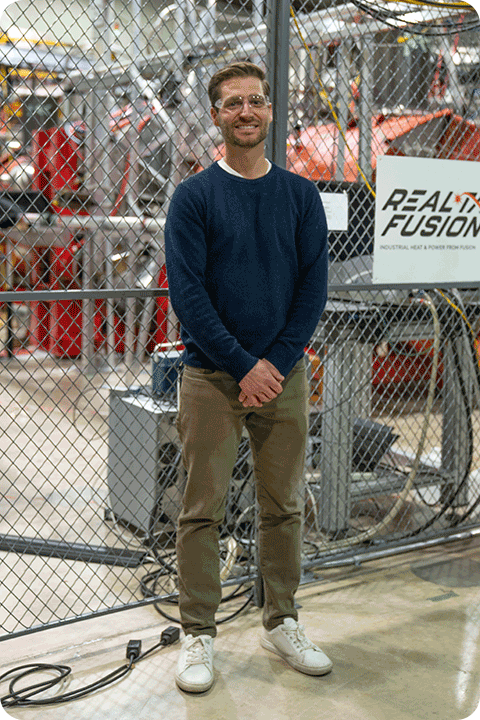
By Dominick Bindl, Vice President of Technical Development, Realta Fusion
A career at Realta begins with a copy of How Big Things Get Done. This book highlights the checkered history of megaprojects and distills the secret of success into a simple directive: think slow, act fast. Thinking slow is to plan considerately. Measure twice, cut once. Acting fast is risk mitigation. Each elapsed second during execution invites disruption from factors beyond our control. Unexpected storms ruin crops in the field – whether rain storms or geopolitical. Big projects fail when planning is rushed, and when execution lags.
Fusion projects – focused on delivering fusion energy as a new and commercially competitive energy source – require a deep partnership between slow thinking and fast acting organizations. Fusion demands the deliberate approach of academic research institutions like UW–Madison as much as it requires the breakneck pace of private companies like Realta. They measure twice, we cut once, and together we will advance fusion to a place neither of us could take it alone.
A Modest Public Fusion Giant: The University of Wisconsin–Madison
The University of Wisconsin–Madison is a modest Public Fusion juggernaut – the numbers don’t lie. UW-Madison’s fusion legacy stretches back to the 1960’s and has produced 580 fusion-focused PhD graduates. Every private magnetic fusion company on earth employs UW-Madison alumni. UW-Madison boasts 28 fusion faculty, has spun out 3 private companies (SHINE Technologies , Type One Energy , and Realta Fusion ) and operates five fusion machines, one of which – the Realta sponsored WHAM device – set a world record for the highest ever magnetic field applied to a fusion plasma the day it turned on.
The accumulated expertise at UW-Madison is exactly the slow-built knowledge that no startup can replicate on the tight timeline commercialization demands. This institutional knowledge is uniquely capable of evaluating fusion technology roadmaps and measuring fusion progress. Twice.
The credibility that comes with UW–Madison’s legacy is valuable to private fusioneers. Fusion investors and government partners appropriately scrutinize technical work with the base assumption that any too-good-to-be-true claim is snake-oil. The approving nod of an institutional partner boasting six decades of peer-reviewed research and an army of PhDs to its name provides independent validation that no internal technical document ever could. When Realta operates WHAM we are not just running an experiment, we are drawing on sixty years of scientific authority, and value flows both ways.
The New Normal: Public Fusion Needs Private Fusion
The last few decades of fusion R&D has piled insights on paper, waiting for hardware that federal funding can not quickly deliver. Slow thinking, slower acting. Enter private fusion.
Private fusion does not replace public funding, it complements it and justifies more. Federal funding prioritizes R&D with clear near-term economic returns. Historically, fusion has struggled to make a compelling economic case. Now, billions of private dollars have been invested into private fusion companies – demonstrating that commercial fusion is plausible on relevant timelines, and that federal dollars are seeding a domestic industry. Private Fusion is a financial fusion boon.
In addition to direct and indirect financial support, Private Fusion is providing scientists, engineers, and technicians operating with an urgency and focus that public programs structurally cannot sustain. At WHAM, Realta’s team works shoulder-to-shoulder with UW–Madison researchers, compressing timelines to months that would stretch across years if constrained to public funding and process.
There is a third dimension that is easy to overlook. Private Fusion is actively building the next generation of fusion machines. Those machines will become the most powerful experimental platforms in the history of fusion research, and public researchers who have not established partnerships with private developers risk being locked out of fusion’s most important experiments. The era in which universities and public labs held the frontier is ending. The question is whether public fusion researchers will be partners or observers in what comes next.
The Stakes
Fusion is not just another energy technology or an incremental improvement. It’s the only energy source that promises to be inexhaustible, geographically universal, and capable of powering civilization at the required scale — without subsidies, without emissions, without long-lived radioactive waste, and without the intermittency of wind and sun. This is why humanity has pursued fusion for seventy years. This is why the cost of failing to deliver commercial fusion is not measured in dollars or decades, but in the kinds of futures that may become unavailable to the next generations.
And the window is genuinely open. Private capital is flowing. Machines are being built. World records are being set. But windows close. Investor patience is not infinite. Geopolitical storms roll in. The crop is in the field and the weather is always changing. We must harvest now, and the partnership between UW–Madison and Realta Fusion is proof positive that public-private partnerships can be built for this moment.
Fusion is more than a megaproject, more than a gigaproject, a teraproject, or a petaproject. Humanity needs fusion if we want to provide a modern quality of life to 10 billion people without destroying our planet. Fusion is a terra-project, and failure is not an option. To deliver it, public and private fusioneers must collaborate to think slow and act fast. Because this is how big things get done.
Related Posts