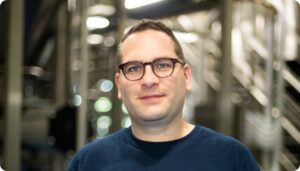
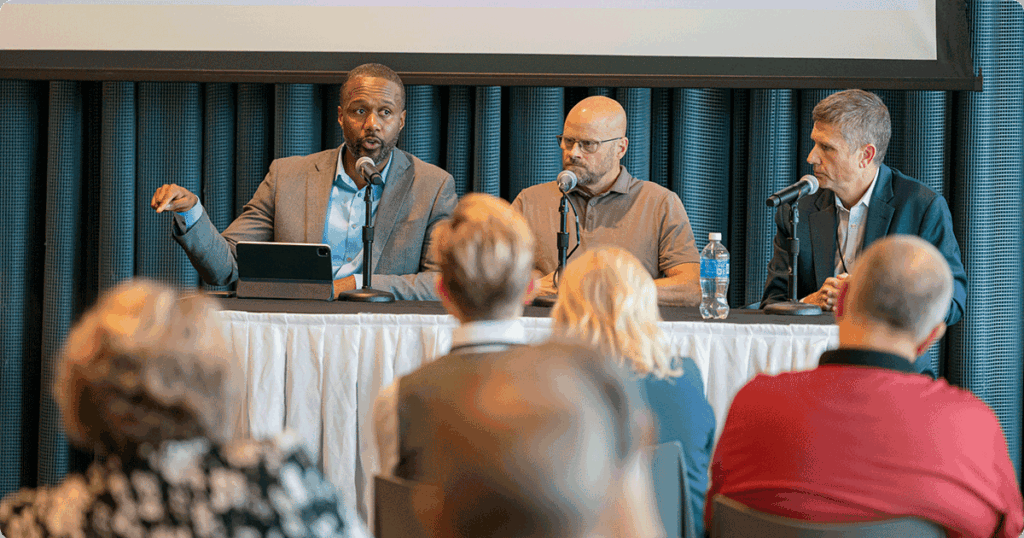
Panelists: Aaron Towns, Matt Zacher, Ben Wehmeier
A panel at the 2026 Wisconsin Economic Summit featured three stories with common themes: losses that seemed unrecoverable, major employers pulling out and taking jobs with them—and resilience that led to recovery and a community that looked different than anyone might have imagined before the story began.
Panelist Aaron Towns, a commercial bank executive and a board member of the Kenosha Innovation Neighborhood (KIN) said despair descended on the city after a Chrysler plant closed there about 15 years ago.
But Towns took comfort in former Mayor John Antaramian’s reminder, as he recalled it: “We’re tough people. Yeah, we’re dealing with some very harsh circumstances, but we don’t break easy.”
After years of planning and forging community consensus and partnerships, KIN emerged in the heart of Kenosha. The project is the revitalization and transformation of 107 acres of vacant land in the heart of Kenosha as a collaborative, mixed-use development that is bringing the community together to define and deliver a regional destination with sustainable, innovation-focused office, medical, educational, commercial, and residential space.
Part of the vision was to boost housing and business creation, to create an inclusive neighborhood, and to benefit kids. The development includes a new Kenosha Children’s Library, and partnerships formed with educational institutions also created new technical training programs.
“Last October, we opened a 64,000-square-foot innovation center across from the second-best STEM school in the state, Lakeview High, because someone had the vision and the tenacity to suppress internal bias, go beyond their limited scope of awareness, and reach for higher heights for what’s possible and was courageous enough to materialize it,” Towns said.
Attracting new businesses, creating a buffer
Jefferson County also felt the economic sting of losing a major employer when Tyson Foods closed a plant in the city of Jefferson. Ben Wehmeier, CEO of the Greater Watertown Community Health Foundation and former county administrator, said community leaders gathered for a 2022 housing strategy retreat.
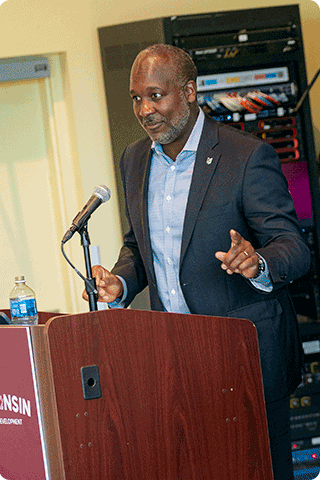
Moderator: Elmer Moore, Executive Director of WHEDA
“What came out of that is us creating a financial gap tool to attract developers to our region to start housing,” Wehmeier said. “There really had not been a brand-new piece of land platted for new housing in the county since the Great Recession.”
Emerging from those talks was a local development fund that started with $1 million from the county and $2 million from the foundation—and which today has grown to $13 million from the public and private sectors and philanthropy.
“The awesome thing is that almost every dollar is in the pipeline,” he said. “There are projects going on in almost every community in Jefferson County because of that fund.”
Jefferson County also stepped up its business attraction efforts. Leaders settled on the development of a food and beverage campus, aiming to attract that sector. Local officials huddled with WEDC, Madison College, workforce development officials, and other education officials.
Ultimately, Japanese soy sauce maker Kikkoman chose Jefferson from 64 sites nationally to invest $560 million over 10 years in a production facility which opened in Jefferson in October 2025, expanding the company’s longstanding presence in Wisconsin; an ethanol plant expansion has also been announced.
Wehmeier stressed the importance of partnerships and including the community—both formal and informal community leaders—in strategic planning. “Sometimes those informal leaders are just as impactful, if not more so, than our formal leaders,” Wehmeier said. “Engaging them early is very important. Honoring your plans is the other part.”
Community advocacy and collaboration
Six years after the closing of the sprawling Consolidated Papers mill in Wisconsin Rapids, officials continue to map the industrial site’s future. A proposal for a large data center stirred community opposition, and early in October the City Council unanimously imposed a yearlong moratorium on data center development.
During the pause, the city will work to develop a regulatory framework and make code and ordinance changes to address data center concerns. Mayor Matt Zacher said that while he understands the opposition, he thinks the project could eventually be made acceptable.
“Nobody wants a bad data center in the center of their city,” Zacher said. “This is all technology that’s been built over and over again and can be done right.”
But Zacher said that the city and its partners aren’t standing still on economic development issues. “The biggest thing we’re focusing on right now is to bring that new spirit of entrepreneurialism,” Zacher said.
The city, county, the schools, and Mid-State Technical College worked together to create a dual-credit entrepreneurial business associate degree program so high school students can graduate with an associate degree in business management and entrepreneurship, he said.
The Chamber of Commerce worked with Mid-State to create a nine-week business development program, and the community is also working with the University of Notre Dame in a business initiative program for rural communities that matches local entrepreneurs with mentors.
“Hopefully what we ignite goes 20, 50, 100 years into the future and takes us to that next level, because it’s not going to necessarily happen while I’m here,” Zacher added.
Although their circumstances differ, the three panelists shared a common goal: Helping their cities thrive and building a resilient, community-based future. Asked to complete a sentence about Kenosha’s future reputation, Towns said: “We came together to build economic access for all.”
Related Posts