
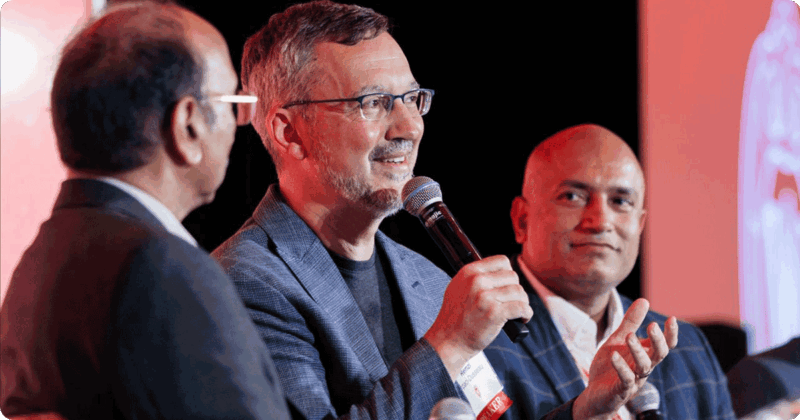
Remzi Arpaci-Dusseau speaks on a panel of University of Wisconsin–Madison deans on how AI is shaping the professional landscape and the future workforce. Photograph: Frank Carmona Ramírez
As business leaders grapple with the use of artificial intelligence (AI) and integrate the technology into their workplaces, leaders at the University of Wisconsin-Madison are finding innovative ways to serve their needs.
Faced with technical, ethical, and business questions, Wisconsin’s flagship university is meeting the rapidly evolving technology with a multidisciplinary approach and changing to meet the demands of employers and society.
Three academic deans told an audience at Milwaukee’s Summerfest Tech in late June that UW-Madison’s comprehensive, collaborative structure—spanning engineering, business, life sciences, humanities, medicine, law, and computing—positions it to act as connective tissue rather than a siloed tech institution.
“Trust in tech is not super high right now,” said Remzi Arpaci-Dusseau, founding dean of UW-Madison’s newly created College of Computing Science and Artificial Intelligence . “I realized that there’s opportunity for us to be a trusted voice in this space, to think about the next generation and to think about a version of whatever we’re putting forward, in which the person is at the center of it.”
Navigating a quickly changing landscape
The university responded by creating the new college, and by encouraging cross-campus collaborations and outreach to industry statewide.
Arpaci-Dusseau was joined during the program by Wisconsin School of Business Dean Vallabh Sambamurthy and College of Engineering Dean Devesh Ranjan.
Academic institutions need to have a voice in debates about AI and help sort through some of the thorny issues it presents, said Ranjan.=
“We’re flying multiple planes right now, and the air traffic controllers are missing in action,” said Ranjan.
AI is one of six “engineering moonshots” that the college is tackling, along with issues such as precision health, quantum tech, and environmental challenges.
Ranjan said the moonshots are too big for engineering to solve on its own, but by building partnerships across disciplines, advances can be within reach.
He added that university collaboration with private industry is also a priority at UW-Madison. “We’re taking a step forward and not just thinking about the research side, but how we work with the business ecosystem in the state,” Ranjan said.
Ranjan has begun Project 72, which involves visit to every Wisconsin county to assess strengths and needs to build the future of state manufacturers, educators, entrepreneurs, workforce leaders and students. Then, university officials will have an opportunity to connect them with universities, tech colleges, industry partners, and resources.
Sambamurthy said benefiting the societal and economic interests of the state is among the school’s five strategic pillars. “We are committed to working with the engineering school in advancing a manufacturing mindset across the state, and AI is a big part of that conversation,” he added.
Applications for the workplace and healthcare
Sambamurthy said his school is working to identify Wisconsin companies and determine their upskilling needs as the workplace changes.
“We’re leaning into our curriculum where all students will work on live industry projects,” he said. “No other business school is doing it at that level, and I suspect that in the next couple of years, at least 40% of those projects will be AI-oriented.”
The business school is also partnering with the School of Medicine and Public Health to work on issues surrounding rural healthcare. “We are much better off connected rather than siloed, and that’s what gets me excited about our new horizons,” Sambamurthy said.
The business school has launched a three-year experimental online undergraduate degree program in which students can learn remotely at their own pace and put into place success coaching for first-generation college students.
Arpaci-Dusseau said his college will underscore not just the science but the ethical real-world considerations inherent in AI.
“We’re trying to produce educated citizens who are active in the world and can help shape the discourse,” he said. “At the core of it is education and empowerment of the individual to go out into the world and try to help shape that better future where humans are at the center of it—and benefiting from it instead of feeling like it’s something that’s being done to them.”
Related Posts