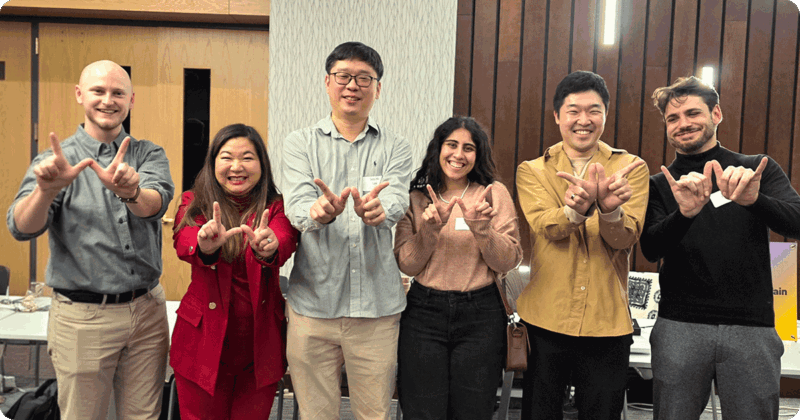
Pictured from left to right: Clayton Custer, gener8tor Managing Director, Shayna Hetzel, WEDC Vice President Entrepreneurship & Innovation, Seoho Lee, Exerchain Chief Technology Officer, Zainab Hameed, WEDC Entrepreneurship & Innovation Program Manager, Jay Li, Exerchain CEO, Guido Mazzo, CEO Iter Idea
The best ideas know no boundaries—and a new initiative aims to bring entrepreneurs from around the world to Wisconsin for the purpose of growing their startups in the U.S. With the help of the effective resources that exist for entrepreneurs here—incubators and accelerators, plus a thriving ecosystem with strong industry-academia connections—these businesses are using their time in Wisconsin to scale their ideas for future success and broader impact.
The new initiative, Accelerate Wisconsin, launched in fall 2025 with an invitation for startups to apply. In the inaugural group, several startups have been selected, with some already moving to the state.
“As these high‑potential founders strengthen their roots here, they can help open bridges to new markets and partners, ultimately anchoring more innovation, job creation, and capital attraction across the state,” says Shayna Hetzel, vice president of entrepreneurship and innovation with WEDC, which provides funding support for the new initiative.
One CEO has already relocated to Wisconsin. Adyan Tanver, CEO of Cove, moved to Milwaukee from Toronto after being selected. His business, which helps companies launch their own financial products, has clients including insurance companies, real estate, and a credit union. Cove has already made some new hires in Wisconsin.
Another company that arrived in Wisconsin last fall through the program is Exerchain, with Seoul roots. The company creates smart devices that use AI to predict what someone’s future health may be, storing data on more than 40 body metrics, including body fat, muscle mass, and water weight as well as exercise habits. Then it supplies a predicted weight in one, three, and six months from the present, modeled based on current habits. Through this, the company says it can help customers know whether habits are working, to plan with confidence and provide greater motivation.
New initiative generates strong interest
gener8tor , the Madison-based startup accelerator, chose these startups from more than 1,000 applications that were submitted. To recruit companies, gener8tor ran ads and hosted lightning round sessions in various countries, making use of its vast network of connections with startup communities and founders in locations around the world. The selected companies are startups with high growth potential, meaning companies that hope to grow into the hundreds of millions of dollars and want to employ hundreds of people within the next 7 to 10 years.
“We’ve just been super excited and impressed with the startups that have moved here already,” says Hetzel. “And the interest in the program has just been bananas, which is so fun.”
Accelerate Wisconsin is administered with funding from WEDC; the global accelerator and venture capital firm gener8tor will work with local partners including economic development organizations and universities to select startups to support. The goal is to select between 12 and 16 global startups whose founders will come to Wisconsin for one year to live in the state and launch companies as they go through an incubator or accelerator program.
The startups selected so far include Italy-based ITER IDEA, focused on building cloud services to support businesses of all sizes. Founder Guido Mazza was selected to participate in the gBETA program at the Waukesha County Technical College (WCTC) Applied Artificial Intelligence (AI) Lab. After spending October through December in Wisconsin, Mazza plans to return this spring. A key goal for his time here is to build initial connections with companies that can use ITER IDEA’s AI-based scheduling solutions for manufacturing. Mazza says the company applied to the program hoping to connect the European venture’s technology with U.S.-based manufacturing companies—and to learn from mentors in Wisconsin. “As an international founder, I saw a valuable opportunity to learn directly from experienced executives, system integrators, investors, and enterprise customers in Wisconsin,” he says.
Bringing fresh energy
Hetzel noted that the new founders coming here will both benefit from the resources that already exist and further enrich Wisconsin’s startup environment.
“They’re coming here with their fresh ideas, their global networks, their customers, and their innovations—and that only amplifies what we’re already growing here,” Hetzel says. “Our ultimate goal is to have more startups launch and grow here in the state.”
The resulting connections can create long-term impact and enduring relationships, leading to increased exports, expanded research partnerships, and more.
“As more international companies plug into Wisconsin’s ecosystem, the density of talent, capital, and collaboration will sharpen and accelerate our economy,” says Hetzel.
The startups will be anchored in four locations. Milwaukee and Madison will host a variety of startup industries, from material science to biomedical devices. Green Bay is similarly general but also specializes in health, nutrition, and food. And in Waukesha, the program is tied to the WCTC Applied AI Lab, so those companies are AI-related startups.
Companies can apply through gener8tor, which will handle recruitment and scouting.
Craig Montuori, director of entrepreneur-in-residence partnerships at gener8tor, said they reviewed 1,500 applications and are down to finalizing the last companies. They will soon make offers to 15 companies for two programs, in Madison and Milwaukee, as well as five selections for Green Bay. Two spots remain for the Waukesha program.
The application process doesn’t require a long-term commitment, Montuori notes. “What we’re looking for in general is just an openness to falling in love with the state.”
He added that it’s important to keep companies that grow in Wisconsin rooted here. Alongside that, he said, is the work to push global companies to consider Wisconsin.
“What if you have a company in Slovenia that has reached the limits of its local capital market, and they’re looking to move to a Munich, a Milan, a Venice—we say, ‘Why not consider Madison or Milwaukee instead?’” he says. “Being in the U.S. is so valuable. … The middle of the country is going to be a great landing pad for them.”
The Wisconsin advantage
Wisconsin attracts entrepreneurs for many reasons; the connections to business and investment throughout the state are one reason. Being a smaller state is also an advantage, Hetzel added.
“What that allows us to do is have really curated and collaborative opportunities,” she said. “There may be only one degree of separation from your first customer, from your first investor, from your first advisor. We think that connectedness of our network and our ecosystem is a competitive advantage.”
Other benefits include the slower pace of life and lower cost of living.
“With a lower cost of living, a more balanced pace of life, and a strong pipeline of skilled talent, Wisconsin gives growing companies a powerful advantage in attracting and retaining their earliest—and most important—hires,” says Hetzel. “It not only allows your workforce to have the wonderful access to Wisconsin’s resources; your business also benefits, because your dollar goes further.”
As part of the initiative, WEDC also signed two memorandums of understanding—with the state of Hessen, Germany, and the city of Monterrey in the Mexican state of Nuevo Leon—to commit to investing in innovation and collaboration.
Beyond supporting new startups, Hetzel notes the state already is home to known huge brands, like Trek Bicycles, Epic Systems, and Harley Davidson.
“We have a history of global innovation, of building big companies that stay in Wisconsin,” Hetzel said. “We’re punching above our weight in how we build innovation to last and grow here.”
Related Posts