
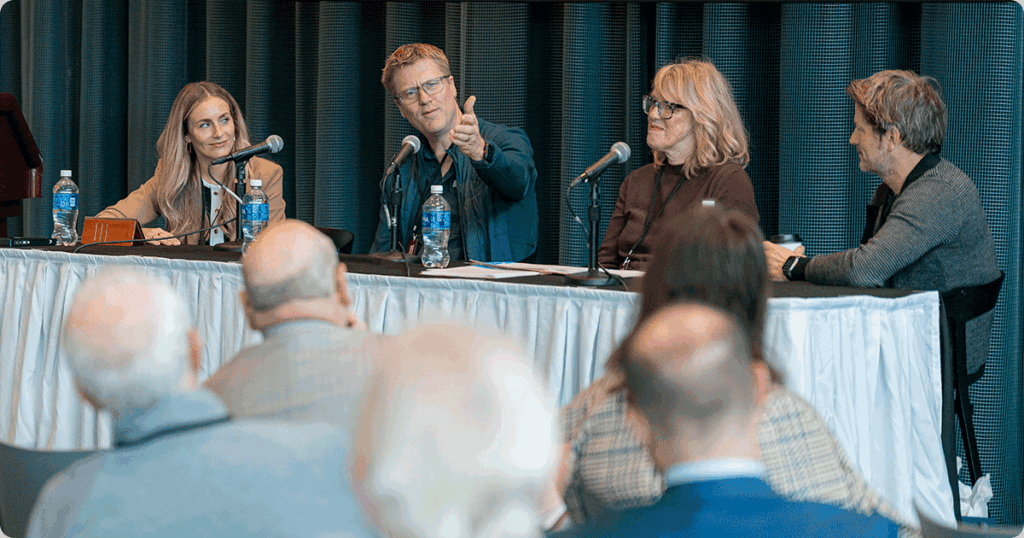
Moderator: Elaine Coughlin, Panelists: Tim Nelson, M.D., Ph.D, Kristie Smith, Zach Halmstad
A panel discussion at the 2026 Wisconsin Economic Summit highlighted the ways collaboration makes innovative ideas possible, showcasing stories from the event’s host community, Eau Claire.
WEDC Startup Ecosystem Director Elaine Coughlin moderated the panel, titled “Regional Dreamers: Building the Communities of Tomorrow.”
Zach Halmstad, founder and former CEO of JAMF Software, spoke about founding the company in 2002 while he was still a student at the University of Wisconsin-Eau Claire, where he majored in literature with a minor in computer science.
A job in the university’s information technology department gave him early expertise used to build the company, which eventually became a global leader in enterprise Apple device management software.
“It became a high that we chased,” Halmstad said. “When there was a problem we fixed for someone, there was an internal high we got from it.”
Although the nature of the problems his company solves are different, Tim Nelson, M.D., Ph.D., cofounder and CEO of HeartWorks, expressed a similar motivation in describing the company’s work. HeartWorks develops therapies for children with congenital heart disease, a condition 50 times as common and twice as lethal as pediatric cancer, but with a fraction of the research dollars devoted to it.
“I like being that guy who tries to envision, with the confidence of the people around me, something that’s never been done before,” Nelson said.
Kristie Smith, executive director of the Habitat for Humanity Starter Home Project, shared about the programs to bring home ownership within reach for more people.
“The average first-time home buyer is 40 years old,” she said. “That’s a problem.”
Collaboration results in imaginative approaches
From research collaborations to office space and economic development assistance, JAMF has benefited from being located in a relatively small community like Eau Claire even more than it might have in a large city with a greater concentration of tech companies, Halmstad said.
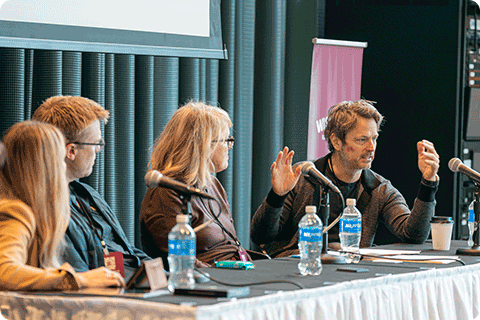 “We’ve tried to make it a two-way street where we are not just asking for something but providing the community with something in return,” he said.
Nelson told the story of a collaboration with Medtronic—the global leader in medical devices and technologies with operational headquarters in Minneapolis—that only came about due to philanthropic investment from the Wanek family, owners of Arcadia-based Ashley Furniture.
Nelson knew Medtronic had technology for a special type of pump that could help kids with congenital heart defects, but the company was wary of licensing the technology since it might be difficult to make back its investment with only a small number of children for the technology to potentially help each year. The philanthropic investment tempered that risk, Nelson said—and the collaboration created a model that can be applied when facing similar problems in the future.
“Now we have a new playbook,” he said. “We have a potential solution.”
Smith spoke about Habitat for Humanity’s shift in focus to helping people stay in their existing homes as well as opening up home ownership for people who couldn’t otherwise afford it. “Giving someone the ability to stay in their home because there’s no longer rain coming through the roof—those kinds of things are also important,” she said.
Related Posts