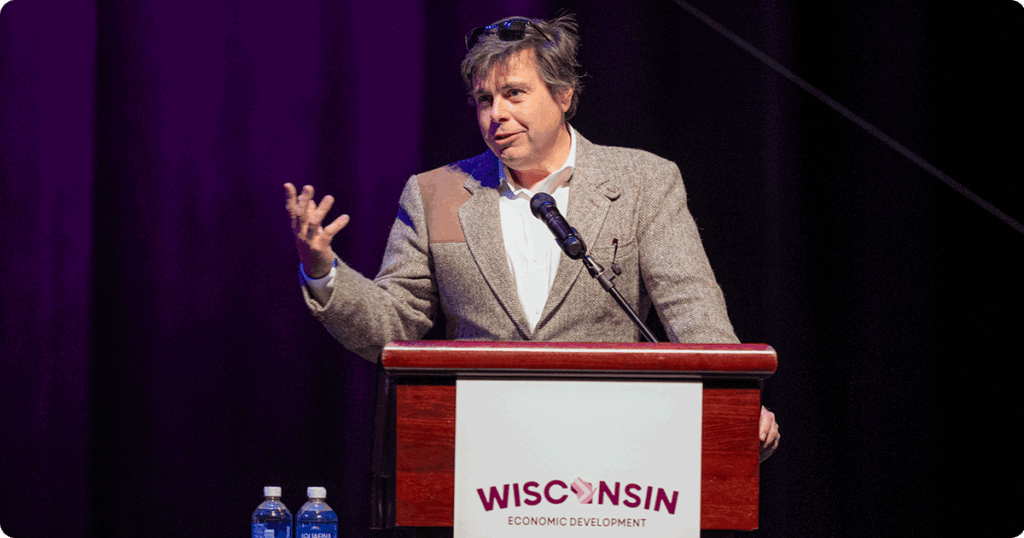
Thomas Kemp, economics professor and department chair at the UW-Eau Claire
It wasn’t always a given that Wisconsin would become a powerhouse of manufacturing, dairy, and agriculture.
“In hindsight, it looks like—well, of course Wisconsin would be an important agricultural state, of course we would build railroads across it, of course we would become industrial,” Thomas Kemp, economics professor and department chair at the University of Wisconsin-Eau Claire, said in his keynote address at the Wisconsin Economic Summit in early October. “But none of these things were inevitable when decisions were made. At the time, they involved uncertainty. They involved risk. They involved people putting money, time, labor, and political energy into things whose ultimate value was unknown.”
Connecting his message to the summit’s overall theme of Determination to Dream, Kemp said the most interesting moments to him are the ones that come right before a big change that will later seem utterly obvious.
“The pieces fit together, but they don’t generally arrive together,” Kemp said. “Someone has to go first.”
If the present moment feels uncertain, he urged listeners to find comfort and even a sense of hope in the idea that many transformative developments in human history followed moments like this one—and he urged them to take an active role in shaping what comes next.
“The point isn’t that crisis is good,” Kemp said, “but crisis forces a question that prosperous times tend to postpone: What needs to change?”
One day, historians will someday look back at the clues that are right in front of us and identify them as the seeds of established trends—and if we bring a mindset of curiosity, we might be able to see those seeds for ourselves, Kemp said.
“The skills we have today can become a foundation for the industries we don’t yet recognize,” he said.
A panel discussion titled “Wisconsin’s Next Big Bets” highlighted two companies whose innovations might be contributing to that foundation: Racine-based DeltaHawk Engines and Madison-based Realta Fusion.
Getting the lead out
When DeltaHawk first launched the idea for a new kind of aircraft engine that significantly reduces lead emissions, aviation didn’t know it was ready for change, said Jon Heup, the company’s president.
It took DeltaHawk 20 years and 100 million man-hours to get its engine certified by the Federal Aviation Administration—the first new certification in 60 years, Heup said. And while many people are embracing the new technology, others still ask, “Why change” something that is proven?
“Right now, general aviation flies mostly on AFF gas, which is leaded-fueled”—which the U.S. Environmental Protection Agency has deemed a pollutant and pledged to ban as soon as 2030, Heup said. Either “general aviation goes away or they find an alternative—so what we do is bring that alternative. … This offers a worldwide solution where there isn’t one.”
‘The holy grail’
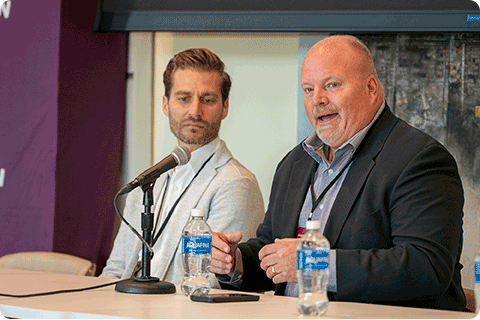
Dominick Bindl, chief operating officer at Realta Fusion and Jon Heup, president of DeltaHawk Engines
Since it was first demonstrated in a lab in the 1930s, fusion has been viewed as “the holy grail of energy formation” because it doesn’t pose the challenges associated with other energy sources and “it does not generate any emissions,” said Dominick Bindl, the company’s chief operating officer.
“Energy is fundamental to literally every single economic activity or element of our daily life,” Bindl said. “As energy use goes up, every single quality-of-life metric goes up. We live on a planet today that’s heading towards 10 billion people—and only like 2 billion of those people have enough energy to live a high quality of life.”
“When we are successful as a global community in commercializing fusion energy and building machines that can sustain these reactions and deliver the energy from it,” Bindl said, “not only is fusion energy going to be competitive—from an economic cost curve without subsidies—with every other form of energy generation today … it’s also going to provide the opportunity to fundamentally undercut the cost of energy generation as compared to other energy generation sources. So that’s the vision. That’s what we’re all kind of marching toward.”
Uniquely Wisconsin
For both Realta and DeltaHawk, Wisconsin’s manufacturing prowess has been key.
“Wisconsin has a concentration of engine manufacturing, so there is a lot of knowledge here we can draw on,” Heup said.
In deciding where Realta would build its plant, Bindl said, “We were hyperaware of the fact that fusion is a giant integration challenge, and it’s the integration of technologies into a machine that has to be built right, so the fact that Wisconsin has such a deep heritage in manufacturing that is at the kind of leading edge in making things with ever-more-exacting precision and ever-more-capable performance—that was front of mind for us, no question.”
And with integrating science and technology a tremendous part of the equation, “being adjacent a deep fusion research and development center such as the University of Wisconsin, from which we spun, had really significant value,” Bindl said, describing the university as one of the “top five fusion research centers on the planet.”
“The piece that pushed Wisconsin over the line for us as we were conducting this site search was really the partnerships,” Bindl said. “Conducting a project of the scale of Realta in a private investor-backed ecosystem has a unique set of challenges, and we have to move at pace, and we have to focus on just the problems that need to be solved at the expense of all the others. We don’t want to reinvent wheels where we really don’t need to, and here in Wisconsin, we really felt the backing of the entire ecosystem. I mean, uniquely in Wisconsin did every member from utilities, the Legislature, the Governor’s Office, research partners, manufacturing people—people just came out of the woodwork just looking for how they could help.”
Related Posts