
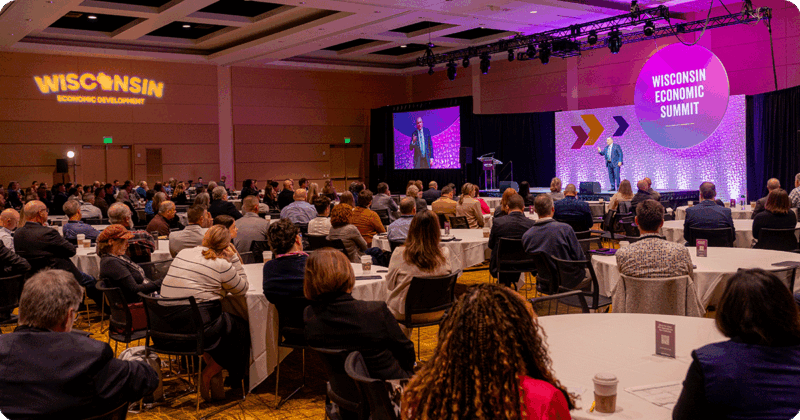
Wisconsin’s collaborative spirit positions it well to navigate turbulent trends such as tariffs, disruptive technologies, and workforce constraints, presenters at the Wisconsin Economic Summit said.
Wisconsin’s collaborative spirit is its biggest asset in the quest to unlock investment in the state’s economy—this was among the themes that emerged from the 2025 Wisconsin Economic Summit, which brought together more than 400 attendees at Green Bay’s KI Convention Center on Oct. 15-16.
The summit explored themes including overcoming workforce challenges, building community support for future-oriented growth, and broadening perspectives on risk to encourage innovation and growth.
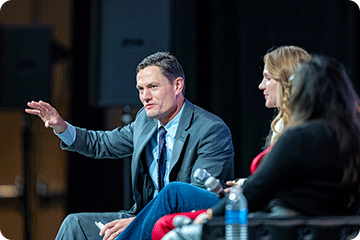
Sam Rikkers, WEDC Deputy Secretary and Chief Operating Officer
“Unlocking investment isn’t just about dollars. It’s about the people and places in Wisconsin,” WEDC Deputy Secretary and Chief Operating Officer Sam Rikkers told the gathering. “Wisconsin’s success depends on community vitality and business growth.”
Chef Paul Bartolotta, owner and co-founder of Bartolotta Restaurants, echoed that message. Bartolotta, the conference’s opening featured speaker, said his group of 18 restaurants and catering facilities in the Milwaukee area aims to “elevate the social fabric of the communities in which we operate.”
In his luncheon address, Green Bay Mayor Eric Enrich also emphasized the importance of partnerships, which “are so essential to growing this city.” Genrich said support from WEDC and from the Wisconsin Department of Administration have helped with job growth and economic development. A $500,000 WEDC Idle Sites Redevelopment Grant authorized in 2021 was “the key” to kicking off a multi-year waterfront redevelopment project that will be “transformational” to the city, he said. And a grant for $1.8 million from the state’s Opportunity Attraction Fund, administered by WEDC, helped cover public safety costs that resulted from Green Bay hosting the 2025 NFL Draft in April, drawing about 600,000 visitors to the area.
Devising strategic solutions
Rikkers acknowledged that the state has challenges—including affordable housing, child care, and a workforce shortage—but said those challenges offer an opportunity to rethink strategies for growth.

Dana Guthrie, managing partner, Gateway Capital
With Wisconsin lagging behind neighboring states in venture capital investment in startups, WEDC Vice President of Entrepreneurship and Innovation Shayna Hetzel said investors should be taking a longer look at Wisconsin for its exceptional workforce and supply chain. “We have so much unmet potential in Wisconsin,” Hetzel said.
In a panel discussion titled “Broadening Risk Perspectives to Encourage Innovation and Growth,” Dana A. Guthrie, managing partner at Milwaukee-based Gateway Capital, said Wisconsin needs to expand its history of entrepreneurial success from manufacturing to fast-growing areas such as technology, software, data, and artificial intelligence (AI).
When companies expand, they create more jobs and wealth in communities and state, said panelist Maggie Brickerman, incoming president of the Wisconsin Technology Council. “When you think about the overall economy, we need that slice to be fired on all cylinders if we’re going to really meet our full potential.”
Communities as an economic building block
Knowing the future of his small rural school district in North Central Wisconsin depended on the vitality of the community in which it is centered, and vice versa, Gilman School District Superintendent Wally Leipart rallied residents, students, and local leaders to revitalize Main Street and strengthen civic life, with assistance from the Community Economic Analysis for Rural Wisconsin Communities program, a joint effort between the University of Wisconsin-Madison, the UW Division of Extension, and WEDC. “It’s just amazing how things have transformed in just a short period of time,” Leipart said in a panel discussion.
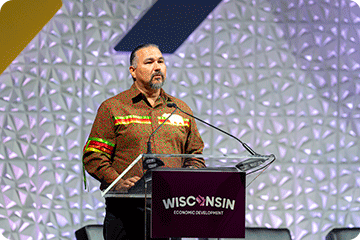
Oneida Nation Chairman Tehassi Hill
Investing in community is also the keystone of the state’s 11 federally recognized Native American Tribes. Oneida Nation Chairman Tehassi Hill, one of the summit’s featured speakers, said the Tribe’s diverse businesses—including a hotel and casino, golf course, engineering companies, retail companies, and apple orchard—are an economic engine for the state, as well as for the Oneida Nation, providing an annual financial impact of more than $750 million that supports education, health care, public utilities, police operations, and social services for Tribal members.
With demographic trends including an aging population constraining the availability of capable workers, Wisconsin employers are applying creative strategies to attract and retain the workers they need now and for the future, panelists said in a discussion on workforce issues.
With a diverse workforce of 1,400 employees, JBS Foods in Green Bay employs nine interpreters to assist workers with language barriers and has built partnerships with local nonprofits and agencies to help workers and their families with needs such as housing and child care, said Sabrina Zerhouni, human resources and engagement leader for the company. In 2021, JBS donated 26 acres of land on the east side of Green Bay and half a million dollars to the city to build affordable housing.
Sachin Shivaram, CEO of Wisconsin Aluminum Foundry in Manitowoc, said employers are losing decades of experience as longtime workers retire. “We’re attracting a different sort of person to our workforce, often with no manufacturing experience,” Shivaram said, while increasing automation is adding to training needs.
Two-thirds of his new hires are immigrants—who now make up 22% of employees, compared to less than 3% just a few years ago, Shivaram said. “We’re having to do things that attract people to come to our communities, whether it’s child care, education, or housing” and “trying to be a more holistic employer, addressing a person’s whole life as a way to get them to come to our company and stay.”
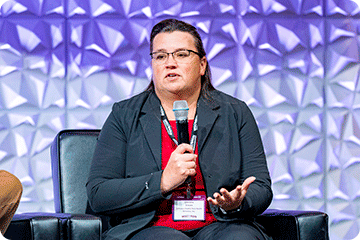
Christie Draves, vice president of accounting and finance, Johnson Health Tech North America
A panel on exporting largely focused on the challenges presented by tariffs enacted under the current administration—but despite those challenges, panelists said Wisconsin remains a desirable place to do business.
Christie Draves, vice president of accounting and finance at Cottage Grove-based Johnson Health Tech North America, spoke about the company’s aspirations for further expansion in Wisconsin. The reason for those aspirations, she said, is “our people. It’s our strong base of the high level of intelligence and the skill set that we have right here in Wisconsin.”
A similar theme emerged during “Investing in the Future: Voices of Wisconsin’s Next-Generation Leaders,” which featured young adult panelists—with Wisconsin natives and transplants alike voicing a desire to stay and make a life here. “I think one of the things that makes Wisconsin so special is the community,” concluded Adina Kurzban, a senior at UW-Madison and intern in the Wisconsin Office of Rural Prosperity.
