
BrainXell

Biotech firm uses grant funds to connect in Europe
BrainXell seeks to expand in overseas markets
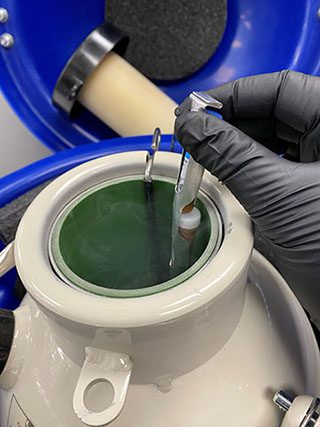
BrainXell products being prepared for shipment
To one day benefit people with neurological diseases, a Madison biotech firm is honing in on ways to accelerate research.
BrainXell was founded in 2015 by University of Wicsonsin-Madison neuroscience and neurology Professor Su-Chun Zhang in conjunction with the university’s Discovery to Product (D2P) program. Recently, the company was able to establish a European presence with the help of WEDC’s International Market Access Grant Program.
“Most of our customers work in industry at companies developing drugs for serious [central nervous system] disorders,” says Michael Hendrickson, the firm’s vice president of operations—and many of those customers are not based in the U.S.. “About half are in other parts of the world, mostly in developed nations,” he says.
Through its work to manufacture customized and nervous system cells, BrainXell helps neuroscientists throughout the world by developing products and services with biotech and pharmaceutical partners. The idea is to use the company’s proprietary technology to guide human stem cells into highly enriched, specialized neurons.
Cells like the ones BrainXell produces can be used to help better understand neurodegenerative diseases, neuroinflammation, and brain injuries—potentially leading to improved brain-related therapies. The company is based on proprietary technology of directed differentiation of human stem cells and provides a range of high-purity neurons. Eventually, the hope is that related research will be able to help patients with neurological conditions.
In March, BrainXell announced the launch of its human induced pluripotent stem cell (iPSC)-derived sensory neurons, a scalable human cellular platform engineered to support reproducible functional studies in fields like pain biology.
In a company highlight of her work, Senior Cell Culture Scientist II Ash Massman said, “We really care about results, because we know they impact people’s lives dramatically.”
Reaching beyond borders
Although the firm has a network of distributors in Europe and Japan, it was looking to boost its European exposure by attending a pair of trade shows, one in the United Kingdom and another in Germany.
The company applied for and received am initial $10,000 International Market Access Grant (IMAG) from WEDC, hoping to make connections that would expand its business opportunities overseas. But the COVID-19 pandemic, with its strict limits on travel and personal interaction, disrupted that plan. So, the company shifted gears and instead used the grant to beef up their presence in Europe.

Michael Hendrickson, Vice President of Operations, BrainXell
Hendrickson says the campaign served as a stepping stone for growth.
“There’s a significant market opportunity that we are working hard to capture more of, and we are using this grant as part of that,” he says. “It allows us to accelerate things that we want to do.”
Since then, they have attended ExporTech™, an export acceleration program with the Wisconsin Manufacturing Extension Partnership and the UW-Stout Manufacturing Outreach Center. This allowed them to qualify for another IMAG in a larger amount: $25,000.
Hendrickson says they have been able to use grant money primarily to enhance the company’s presence at international scientific conferences and trade shows. For example, they attended ELRIG Drug Discovery, a leading drug and life sciences conference in Europe, which covers topics ranging from biophysics and oncology.
“Before the grant, we rarely did non-domestic events,” he says, adding that the company has also hired a larger European distributor.

From Wisconsin to the world
The company has 35 employees in the state, including in a new facility in Madison’s University Research Park; all but two employees are based in Madison.
In the lab, they are producing high-quality human neurons and glia for researchers and scientists. Hendrickson notes that the cost to operate is lower in Wisconsin, which helps their overall budget.
“Because we ship all products overnight,” he says, “our location here does not affect our ability to meet the demands of our customers.”
Note: original BrainXell success story posted in August 2023
