
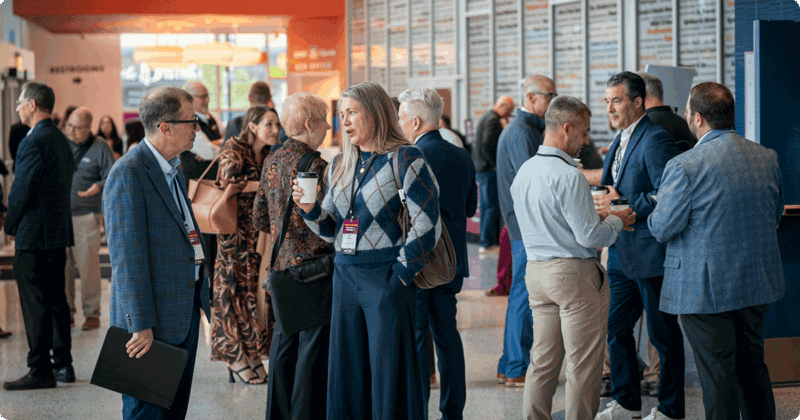
Economic development dreams for the future—whether they belong to entrepreneurs, communities rebuilding themselves, young people seeking a place in the economy, or businesses seeking to expand—are rooted in today’s ever-changing realities.
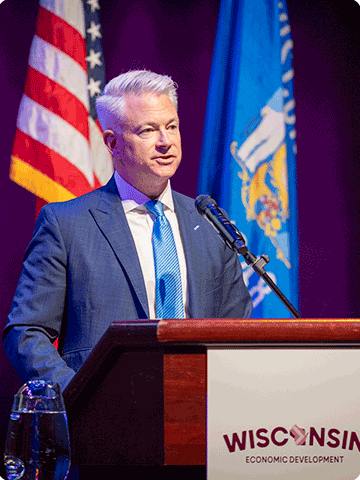 The theme for the fifth annual Wisconsin Economic Summit, held at Eau Claire’s Pablo Center at the Confluence Sept. 30 and Oct. 1, was “Determination to Dream,” and WEDC Secretary and CEO John W. Miller made clear that that theme was not inspirational fluff.
“Dreaming is not optimism, it is not wishful thinking, and it is definitely not putting the word innovation in front of something and hoping for the best,” Miller said as he kicked off the summit. “It is the ability to look at what exists today, imagine something better or different, and then have the determination to make it real.”
Miller pointed to the willingness to take risks on big ideas.
“Some will work and some, unfortunately, will not,” he said. “We tend to look backward at successful ideas and think the outcome was inevitable. It almost never was. Somebody just kept going on long enough that eventually the rest of us could see what they saw.”
Confronting a K-shaped economy
Sifting through today’s realities is no easy task, speakers noted. The nation is faced with a K-shaped economy in which some succeed and others struggle, deepening political and cultural divides, and a democracy in peril.
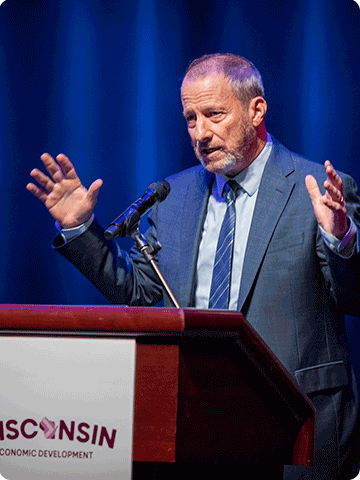 Author and Atlantic Staff Writer George Packer said today’s realities trace their origin to about 1980, as an economic shift toward a knowledge economy and rising inequality meshed with a cultural shift that left some Americans feeling “no longer at home,” and a technological shift in which social media eventually corroded our language.
Packer compared today’s economy to that of the Gilded Age, as the top 10% now own about two-thirds of the nation’s wealth and the bottom half holds 2.5% of the wealth—but he said the deeper cause of a divided nation is not just material.
“The fundamental cause is a sense of having lost one’s value or one’s worth in society,” said Packer. “There’s an erosion of our commonality as Americans, a sense that our social fabric has torn apart, that the central thing that held us together and that we could all sort of refer to as a common reference point has disappeared.”
Katherine Cramer, a UW-Madison political science professor and author of “The Politics of Resentment,” said people are frustrated by a sense of insecurity and feel unseen. That feeling is less about economics, but about “this sense of ‘I’m doing everything that I should be, that I think that I should be or that I’ve been told that I should, and yet it’s so hard to make ends meet.’”
A gap in educational attainment is also behind some of the divisions locally and nationally, as people holding college degrees—only about one-third of Wisconsin’s adult population—make decisions that affect people of every educational status, Cramer noted. While distrust in institutions is rampant, she said, trust in local government is somewhat higher.
Packer said the K-shaped economy matters not just for current circumstances but also for the prospect of social and economic mobility, especially when the chasm between the “arm” and the “leg” of the K becomes so wide that only “extremely energetic, determined, talented, and lucky individuals” can cross it.
Building the future we want, together
Panel discussions during the event’s first day involved Wisconsin mayors discussing community growth and the economic challenges faced by cities, the experiences of early-career young Wisconsinites, and the state’s talent pipeline. The second day’s conference agenda moved on to the “dream” part of the theme, exploring innovation and a vision for the future in various ways.
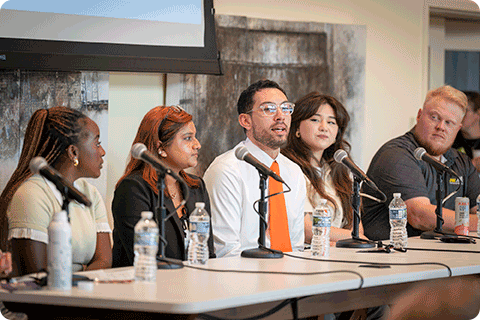 Cramer, who moderated the panel on younger workers, said she was struck by their ability to adjust to circumstances. “One thing I learned—or at least wasn’t expecting to hear—was an awareness of uncertainty and this sense of insecurity, but also this pride in adaptability and agility that they have,” she said.
The young people also told personal stories of how mentors buoyed them, she added. “So much of our conversations were not so much about institutions, but the people within them,” Cramer said. “They all told a story in some respect about somebody or some group along the line that opened the door up enough for them to walk in and gain a foothold.”
Natalie Yahr, a journalist for Wisconsin Watch who moderated the talent pipeline panel, said she was taken with how Layla Merrifield, president of the Wisconsin Technical College System, viewed the future as something not just to forecast but to take an active role in shaping. “She talked about how we need to decide what the future is and build toward that future,” Yahr said.
Emily McFarland, president of the Wisconsin League of Municipalities, led the session with mayors and highlighted Superior Mayor Jim Paine’s approach of asking residents what about their city makes them happy about where they live.
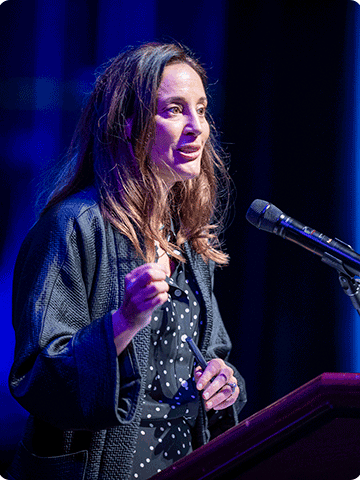 “It was a powerful reflection,” McFarland said. “Too often people who are working to solve problems—day in, day out, all day—can get bogged down by problem-solving and not just asking people about what makes them want to be in our community.”
Capping the first day was a talk by Kate Markgraf, a starting defender on the 1999 U.S. Women’s World Cup Team and the 2004 and 2008 Olympic gold medal teams. She built on the “Determination to Dream” theme by recounting her own soccer journey.
Her tenacity and grit got her through early-career setbacks, small stature, and injuries. Success followed.
“You have to acknowledge the what-ifs, not avoid them—and keep that with you at all times, especially when it’s the hardest,” she said. “Because that’s how we solve big things. That’s how you dream and realize the dream—not just for you, but you end up creating dreams and opportunities for others.”
Related Posts