
Wisconsin cities are confronting the demands of a K-shaped economy in which some households climb economically while others slide as they face an affordability crunch.
“The problem of a K-shaped economy is not about the line sloping up or the line sloping down,” said Superior Mayor Jim Paine. “It’s about what’s missing from the space in between. To me, that’s the gutting of the middle class and an abandonment of small, locally owned businesses.”
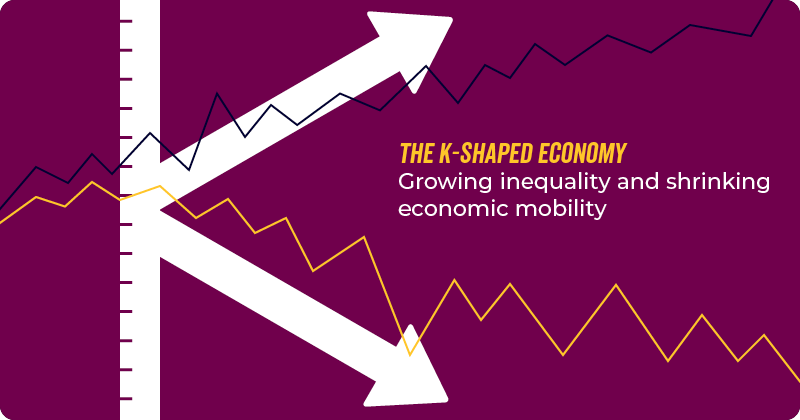
In a K-shaped economy, people who are already better off accumulate further gains while those who are less well-off lose ground, with little opportunity to move between the downward-sloping and the upward-sloping path.
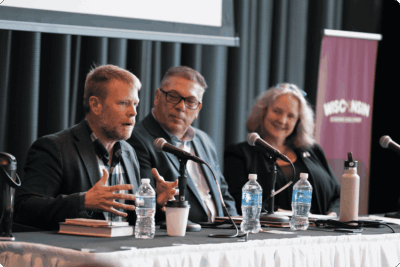
Paine was one of four mayors who detailed their challenges as they wrestle with a changing economy during panel discussions at the Wisconsin Economic Summit in Eau Claire this month. The four communities represented on the panel ranged from Milwaukee (population 600,000) to Dodgeville (population 5,100).
Although their scale differed, their problems overlapped: housing, workforce, and a state revenue system they say leaves them little room to maneuver.
Madison Mayor Satya Rhodes-Conway used a single statistic to summarize the economy faced by Wisconsin residents: more than 30% of Wisconsinites, she said, are asset-limited and income-constrained.
“A third of our state in is this category,” she said. “It looks like homelessness, increasing instability in housing, and wages not keeping up with costs.”
Housing as infrastructure
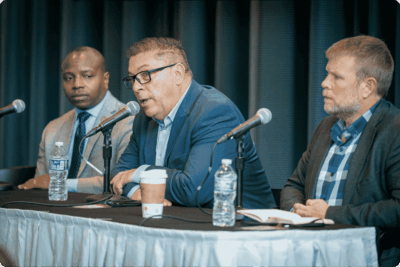
Milwaukee Mayor Cavalier Johnson, Dodgeville Mayor Barry Hottmann, and Superior Mayor Jim Paine spoke about improving access to opportunity in communities across Wisconsin.
Every mayor underscored the dilemma of providing enough housing—especially affordable housing—to convince workers and businesses to locate in their cities and build prosperous lives.
“Housing is not a social issue,” said Dodgeville Mayor Barry Hottmann. “To me, housing is an economic infrastructure issue.”
Employers in Iowa County, including Lands’ End and a hospital investing $70 million, need workers, he said—and those workers need places to live. The city, with the help of the Wisconsin Housing and Economic Development Authority, recently built 54 units of affordable housing.
“We’re not trying to make a bigger Dodgeville. We want to make a Dodgeville that is more attractive to more people,” Hottmann said.
Declaring 2026 the Year of Housing, Milwaukee Mayor Cavalier Johnson worked with nonprofits, tweaked existing programs, and used tax incremental financing to encourage the development of affordable housing. Partly as a result, the city has increased the number of Black and Latino homeowners, a number that had plummeted in recent years.
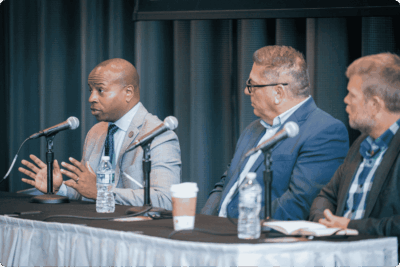 “We’re helping to close that gap, finally,” Johnson said. “It creates more stability in neighborhoods and when you have more stability, that’s good for families. … If the city becomes more stable, it becomes safer and more attractive for future development and job creation.”
Rhodes-Conway said Madison underbuilt housing for decades. She added that her administration tripled the amount of funding for affordable housing and permitted about 18,000 new homes, a significant increase. But because of demand rents and ownership costs continue to climb, pushing workers into neighboring towns.
“They can get a good job in Madison, but they can’t afford to live there,” she said. “And then, we have a transportation problem in addition to a housing problem.”
The mayors also emphasized the importance of creating vibrant, safe cities to attract residents and businesses. Johnson said the health of Milwaukee, the state’s largest city, benefits all Wisconsinites.
“The city has to be safe. It has to be strong. It has to be prosperous,” he said, adding that education plays a major role in that vibrancy. “If kids are in the best position to succeed, that’s the best thing for their families, the best thing for their neighborhoods, and the best thing for the state overall.”
Facing a revenue crunch
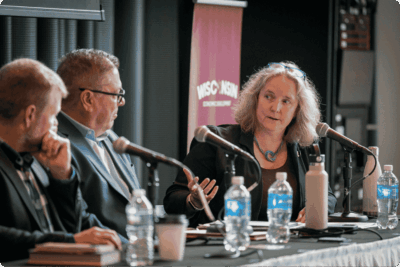
Madison Mayor Satya Rhodes-Conway (right) joined the panel for the afternoon discussion.
Limitations on how Wisconsin lets cities raise money were sharply criticized. Rhodes-Conway said state-imposed limits on the growth of property taxes and city spending mean that a new development doesn’t always pay for itself—and if Madison exceeded its spending limit by a penny, it could lose $9 million in state aid.
“I can’t raise the money, and I can’t spend the money,” she said. “If you walk in the door with a crazy [idea] and you think I’m going to say yes to it because of [the increase in] property tax, that’s a misunderstanding of how we work.”
She added: “It’s not like you build a thing and you’ve increased the value and we all get the benefit. No, we are extremely limited by the state in how much value we can get.”
Paine agreed and also underscored the importance of supporting local business and raising up people who live in the community by building wealth from within.
“If they are coming from outside to invest in your community, where do you think all of that wealth is coming from? From our community and it’s going out somewhere else,” he said. “Just to claim that there’s going to be some unknown benefit because of business or jobs, if the jobs aren’t paying well enough, then it’s not a benefit.”
Paine said Superior will support projects that help residents. He pointed to Fraser Shipyards, which didn’t ask for a subsidy when it couldn’t hire enough workers and instead started a childcare program.
“Just show us why you are a benefit to us,” he said, adding that his city moves quickly for developers. “You will never work faster than us.”
Dodgeville’s Hottmann said he turned down a storage-unit developer after existing operators told him they had no waiting lists. “Just because we don’t have it or you think we need more of it, that doesn’t mean it’s going to work.”
Related Posts