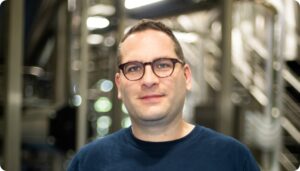
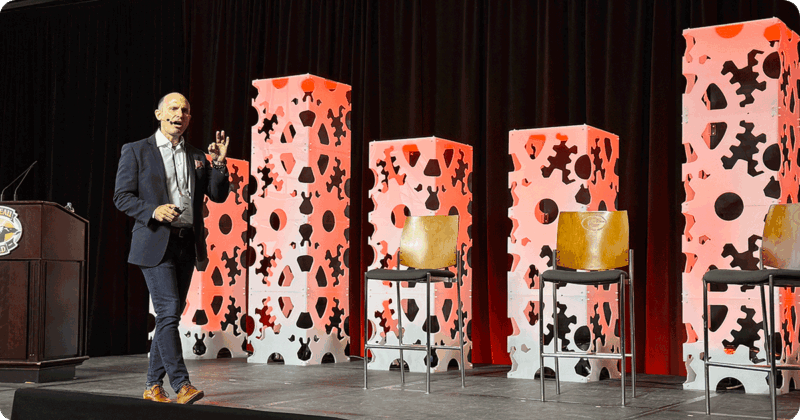
At the Wisconsin Drives Manufacturing Summit, Bob Buttermore, SVP & Chief Supply Chain Officer, Rockwell Automation, shared insights on how innovation, workforce strength, and advanced technologies are shaping the future of manufacturing here at home.
Wisconsin’s manufacturing culture, deeply ingrained in the state’s history and economy, is responding to challenges by embracing emerging technologies, accessing workforce knowledge in new ways, and planning for a bright future.
That was the message conveyed to about 700 attendees at the inaugural Wisconsin Drives Manufacturing Summit at Lambeau Field on June 2.
“The world is chasing our heels,” said Layla Merrifield, president of the Wisconsin Technical College System. “They are working furiously to catch up to what we are doing here, and we’ve got to put our foot on the gas. We have to recognize that this is a team sport and that workforce development is not charity. It is critical infrastructure.”
The daylong series of panel discussions and breakouts, part of a two-day event, brought together manufacturers, technology leaders, education professionals, and industry experts to examine the state of Wisconsin manufacturing and how its future is impacted by innovation, workforce development, and operational excellence.
Technology’s impact
Artificial intelligence’s capacity for improving efficiency and accuracy hold enormous promise for manufacturers but identifying the best ways to use technology while maximizing human talent poses a challenge.
Steve Nackers is director of electronics and connectivity at Sub-Zero Group, a Fitchburg-based luxury appliance manufacturer. Recently an employee came into his office and sat down with a heavy sigh.
“I don’t know what I just did with the last three years of my life,” the employee said. “Everything I learned, everything I did, I just watch AI do all of it in minutes,” Nackers said. “That’s not ego. That’s terror. … As leaders, we have to learn to lift those people back up, get them pointed in the right direction where all of their value and judgment and the skills they have are going to move them in a direction that allows their creative outlets and value to be recognized.”
Leaving the meeting, Nackers said the employee had an idea that AI could help with and did some coding to simulate and test products in ways that were not possible even six months ago.
Implementing AI and automation in targeted ways can yield big results.
Bob Buttermore, senior vice president and chief supply chain officer at Rockwell Automation, said the firm revamped a major facility in Singapore using a digital twin model to help automate processes with robotics and AI, manage energy use, and move products through the line. Use of robotics drove a 35% improvement in indirect labor efficiency, Buttermore said.
The plant has manufacturing on its fourth and fifth floors, and predictive AI, using 240,000 data points, was used to keep a key lift conveyor running at peak capacity.
And even though Rockwell was already a light energy user, the firm saw a 35% reduction in energy consumption.
In addition, Rockwell analyzed hundreds of thousands of data points to reduce training time for service technicians who keep their 394 pieces of equipment humming along. As a result, the 12 months it took to train troubleshooters dropped to four months.
Buttermore said similar approaches will be used in Wisconsin production facilities to help sharpen competitiveness. He offered advice to other firms looking to boost productivity.
“Transformation is cool and fun, but it has to have an ROI,” he said. “This evolution to autonomy is not about eliminating jobs. It’s about supercharging the power of people. Technology is ultimately driven by people. The expertise of people is what creates technology.”
Another challenge confronting industry leaders is strategically planning for a future increasingly dominated by technology. Saumil Shah, managing director of Accenture’s Milwaukee office, said leaders should look beyond headcount and remake employee roles.
“Every automated task creates new work,” Shah said. “If all you do is apply digital capabilities, apply automation and take out headcount, you only have half the opportunity in front of you. You have to think about redesigning the work, the roles.”
Education changes to meet industry needs
State higher educational leaders acknowledged their roles in strengthening manufacturing statewide and making expertise more readily available to manufacturers. Some called for foundational change in the way education is delivered to workers to help build the economy.
Eric Wilcots, interim chancellor at the University of Wisconsin-Madison, called for refreshing the Wisconsin Idea–the notion that university research and education should benefit all people of Wisconsin–in something he called “The New Wisconsin Idea.”
“It speaks to the two-way conversation between the universities and the communities we serve,” Wilcots said. “It is the ability to come together, to listen, to understand, to collaborate, to work together to solve problems, to advance communities and advance manufacturing.”
Wilcots said UW-Madison is working to meet emerging manufacturing needs. It is establishing a new College of Computing and Artificial Intelligence and investing heavily in leading-edge technologies in quantum science, biomedical research, fusion and space manufacturing, and aerospace engineering.
“We are committed to providing a pipeline to meet your needs,” Wilcots said
Tracy Pierner, president of Blackhawk Technical College, called for a restructuring of how technical education is delivered. A decade ago, most technical college students were on a traditional two-year degree path, but today a majority of manufacturing students are incumbent workers.
“We need to turn education upside down,” Pierner said. “We need to make our core product available to you in real time, with the authentic skill development that comes along with it. … That way, the cost of your training will go down.”
“We had to change. You didn’t have to fit our schedule. We met yours,” he added.
Manufacturing leaders said that upskilling and knowledge sharing are critical to their success. Sub-Zero’s Nackers, urged businesses to embrace education.
“Upskilling, to me, is a strategy. It’s not a cost,” Nackers said, noting that Sub-Zero developed technical skills programs for professional employees and partnered with tech schools and trades, as well as high schools, to create an upskilling chain.
That type of pipeline is also working for Kuhn North America, a farm implement manufacturer with a factory in Brodhead. Kuhn’s Michael Froemker said the company does internal upskilling and also pairs assemblers and preppers with local high school students.
“We’ll put them through local training within our facility to keep that pipeline going,” he said. “How do you get people excited about manufacturing again? We’ve all lived through the idea that you need a bachelor’s degree to be successful. That’s not right. But you need education. You need an understanding of problem-solving skills.”
Biohealth flourishes, tackles challenges
An already strong Wisconsin biomedical sector is capitalizing on the state’s designation by the U.S. Economic Development Administration as a Regional Tech Hub specializing in biohealth and personalized medicine.
Sam Rikkers, deputy secretary and chief operating officer of WEDC, said the state’s research muscle, long-term investment, its workforce, and the expanding nature of biohealth will help state manufacturers prosper.
“It’s not a legacy industry that we’re trying to sustain that’s going good one day and bad the next,” Rikkers said. “It’s a place where jobs are booming, companies are coming in, and we can really feel the tide going the right way in Wisconsin.”
Still, biohealth manufacturers are challenged in a variety of ways as they innovate to produce life-changing therapies. Obtaining investment capital, scalability in production, and maintaining a healthy ecosystem are critical to the sector.
Jessica Martin Eckerly, CEO of Forward Biolabs–the Madison-based life science innovation hub that helps early-stage startups launch and scale quickly–said a universal question for startups is how to grow in a way that makes sense.
“They are all trying to do something that has never been done before,” she said. “The way they get through that is to get more data to support what they’re trying to do, but increasingly investors, regulators, partners, they want to know that if you answer the scientific questions, there is some path for scalability and reproducibility.”
Chris Bartley, managing director of Waisman Biomanufacturing at UW-Madison, said accessing venture capital is an ongoing issue in the sector. “That would help with local entrepreneurial initiatives,” he said. “I’m on a university campus and there are a lot of ideas and we need to find a way to get them into manufacturing.”
Ben Kinney, automation engineering manager at Catalent, a pharmaceutical manufacturer in Madison, said biohealth success also benefits other state industries, notably construction firms. “The technical expertise that they use in dairy plants translates really well into what we do in pharma. … That’s an opportunity we have, because we don’t have to go to Europe to buy filtration skids or Thermo Fisher’s Santa Clara office to buy bioreactors.”
Bartley believes that Wisconsin’s biohealth sector is moving in the right direction but raised a question that transcended personalized medicine to address Wisconsin manufacturing writ large.
“The biggest issue here is that change is coming, and we have to be ready for that change,” he said. “We’re looking at how we manufacture differently in the future. How are we going to take traditional models of what we’re doing, change them, and be ready for the future? Do we have the mentality to be ready to take those reins and run with them?”
Related Posts