
Garver Feed Mill
A vacant building becomes an engine for local economic activity
Garver Feed Mill moves from deterioration to historic preservation
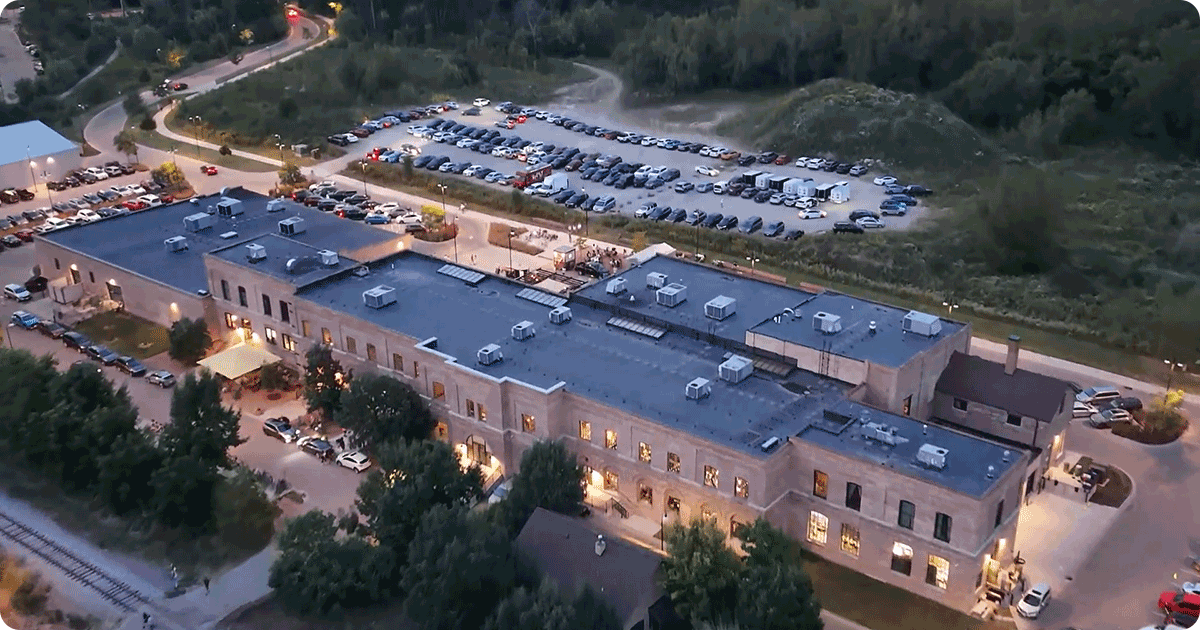
For years, the Garver Feed Mill was a vacant, graffitied building in Olbrich Park in Madison.
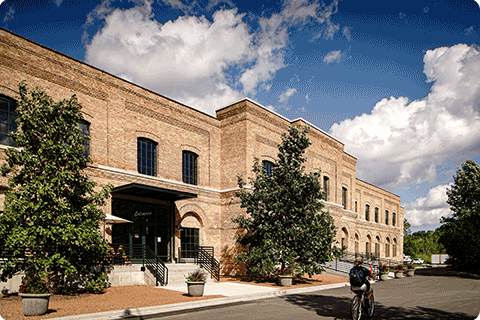
Now, the 58,900-square-foot building is an award-winning home to a collection of producers and artisan food makers, plus a bookstore, a spa, and a catering company. The Mill—located at 3241 Garver Green on Madison’s near East Side—hosts 15 businesses, along with a steady stream of events ranging from weddings and family gatherings to happy hour meetups. These activities create opportunities for entrepreneurs to connect with customers, grow their businesses, and become part of the community they serve. The building has five gathering spaces of different sizes; the location includes on-site catering and cocktails, too.
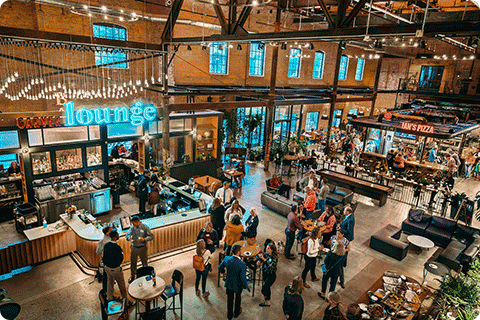 The property has transformed from a local eyesore to an economic engine, drawing visitors from across Madison and beyond—and supporting budding businesses in the process. The project’s trajectory offers lessons in best practices for not just historic preservation and revitalization but also innovative thinking in economic development.
As a Wisconsin native living near Garver in the early 2000s, Bryant Moroder was familiar with what he calls “Madison’s entrepreneurial energy” and the need for unique, community-anchored commercial spaces. As the project manager with Chicago-based Baum Revision, Moroder saw an opportunity to transform the space and help meet that demand.
“That knowledge gave us confidence in the project’s economic viability from day one,” says Moroder. “We knew going into this that Madison as a community was very good at supporting food entrepreneurs.”
He also knew that Wisconsin consistently ranks among the top states for small business support, access to capital, and community investment. “Restoring a landmark like Garver meant we could tap into that ecosystem, attracting tenants, partners, and customers who actively seek out high-impact local ventures over generic commercial alternatives,” he says.
Local investment in revitalization fuels change
In the early 20th century, the building was occupied by the United States Sugar Co., a factory that processed sugar beets. After it was bought in 1929, it was remodeled and became a feed and supply company, which it remained for decades until closing in 1996.
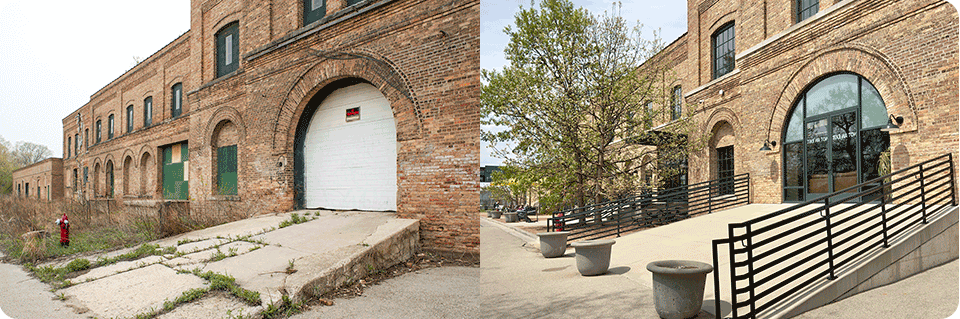
After that, it remained vacant, and the massive space eventually deteriorated to the point that the roof failed, the masonry began to crumble, and the windows and doors became damaged.
In 1996, after Olbrich Botanical Society bought the building as well as the surrounding five acres and deeded it to the city. After other plans were considered, eventually in 2014, the city issued a request for proposals seeking ideas for what the vacant space could become. From the proposals received, the city chose Baum Revision to redevelop the building, and with the City of Madison participating as a partner to invest in the artisan food production facility.
The project received support both from Madison and WEDC to transform the huge, vacant building into their vision of a bustling place with many visitors and with companies flourishing inside. WEDC support included an Idle Sites Redevelopment Grant and a Historic Preservation Tax Credit award. After about five years of construction, the space was fully restored by 2019.
“The transformation was more than just a beautiful old building being repurposed,” Madison Mayor Satya Rhodes-Conway said in a quote given to Baum Revision. “Garver is now a hub for entrepreneurs and a thriving community gathering spot. This is a true success story, and I fully expect Garver to positively contribute to the City of Madison for decades to come.”
Moroder commends the community for taking the initiative to beautify abandoned space, noting that locals were involved in community meetings and rooting for the restoration.
The building is now a historic landmark. It has won multiple awards, including the 2020 Historic Preservation Award for Adaptive Reuse from the Madison Trust for Historic Preservation as well as the 2020 Historic Restoration Award by the Wisconsin Historical Society.
“By every measure, this project has exceeded even our most optimistic expectations,” Moroder said.

Supporting businesses as they grow
The building itself has functioned as an engine for economic development, offering small local companies the room they need to grow. The building is now home to 13 different businesses, including a coffee roaster, a kombucha brewer, a furniture repair shop, a yoga studio, a spa, and restaurants. The space has hosted more than 800 public events.
 Most companies that are a good fit for the Garver Feed Mill have grown beyond the idea stage but have perhaps not grown enough to afford or need their own real estate yet. These growing companies may already have a proven business idea and their first employees but not yet need a full warehouse or standalone storefront. They may not be ready or able to open and operate their own dedicated space and may benefit from sharing a space with others.
In this way, Garver serves as a platform for them to start, grow, and scale their businesses, taking them from the idea stage to actual sales. Many small businesses have benefited from Garver’s opening; Baum estimates local makers have generated more than $5.3 million in sales through events there.
“Garver offered something that is special: the ability to fuse agriculture, entrepreneurship, culture, and history under one roof,” says Moroder. “That combination creates a destination, not just a building.”
Working together to create a “third space”
From the beginning, Moroder says, it was important to work with local residents. They didn’t want to be a company coming in and imposing their plans from outside; they wanted to hear from the community about what it could use and what it wanted.
This approach resulted in a space that is widely used and beloved among locals, who might bike by and grab a coffee from Madison-founded Ledger Coffee Roasters, meet up with friends for cocktails at the Garver Lounge & Bar, or simply come in to sit and craft with their knitting circle. The space fills up for Cheers, Madison! community choir practices, the Femmestival culinary and visual arts festival, and Food Truck Fridays throughout the summer.
Moroder is proud of its function as a “third space”—a place where people can gather that is not home or work. It’s meaningful, he says, to walk into the space and hear people laughing together, sitting together, talking in person, and making new connections. Especially in an era of too many screens, he says it’s been gratifying to create a space where people can simply mingle.
The building has created 247 jobs and draws more than 300,000 visits each year, according to an economic impact summary provided by Baum. In 2025, they estimate it generated $17.9 million in direct local economic activity, including spending by visitors, vendors, and tenants. It also created an estimated $85 million in local economic activity, attracting new business dollars through tourism, events, and destination-based business—with $7.1 million in visitor spending generated in 2025 alone.
“Garver represents an important lesson in partnership and preservation. Combined with Olbrich Botanical Gardens , it has helped create a destination that draws visitors from across the region and supports our quality of life and local economy,” said Madison Parks Superintendent Eric Knepp.
“Garver is more than just a space,” adds Moroder. “It’s really the experiences that people have that makes it more than just a building.”
