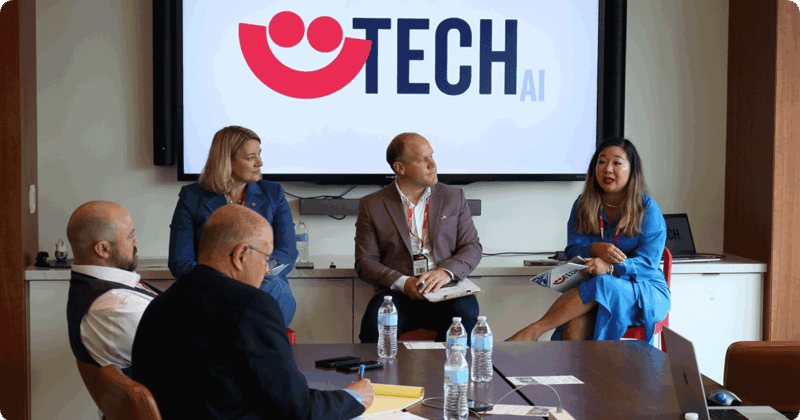
Global expansion can feel like a gamble or a shot in the dark—but with the right support, it can feel strategic and intentional. This was the message of a panel at Summerfest Tech that highlighted the resources Wisconsin offers for home-grown companies looking to expand internationally and, on the other side of the coin, overseas companies looking to grow in Wisconsin.
Summerfest Tech, which began in 2018, leverages the popular music festival’s brand to showcase technology issues and spotlight Wisconsin’s role as a tech hub. At this year’s event in late June, leaders from Wisconsin and Ireland shared how soft-landing initiatives can replace guesswork with partnerships to accelerate growth and targeted global expansion.
Shayna Hetzel, WEDC’s vice president of entrepreneurship and innovation, shared how Accelerate Wisconsin—a new WEDC initiative offered in partnership with Wisconsin-based gener8tor—is working to attract startups from around the globe to move to Wisconsin for one year and establish a presence and market in the state.
“No company scales globally alone anymore. Ecosystems are the strategy,” Hetzel said, noting that Wisconsin is able to tap programs like gener8tor’s Soft Landing Pad , its investor network, and economic development and university resources to help with the transition.
The Accelerate Wisconsin initiative, administered by gener8tor with WEDC funding support, aims to bring 12 to 16 global startups to the state to launch a U.S. presence. Hetzel said the founders help enrich Wisconsin’s startup climate.
The program, launched in fall 2025, has already brought firms such as South Korea’s Exerchain, an AI-powered health and wellness startup to Brookfield; Toronto-based Cove, a firm that helps companies launch financial product to Milwaukee; and Italy-based cloud service provider Iter Idea to Waukesha County, as well as five other companies currently in the Madison and Green Bay regions.
So far this year, more than 1,700 companies have applied for eight spots in Accelerate Wisconsin. Hetzel said gener8tor is finding that the sweet spot for companies that are a good fit seems to be startups with $100,000 to $1 million in annual recurring revenue with a proven customer base and a founder willing to move to Wisconsin.
Companies using Soft Landing Pad are able to connect with relocation guidance, mentorship, investor access, and corporate connections. WEDC is there to offer technical assistance and other guidance. That enables them to succeed sooner and integrate into the economy.
“In weeks, they have secured investments or grants. They’ve been certified by our organization for investment tax credits, and they’ve already started hiring people and looking at office space,” Hetzel said. “Wisconsin is small, and that means we can help you get to a ‘yes’ faster because we can navigate our space with more velocity than larger tech ecosystems.”
Global trade is a two-way street
Of course, that’s not the whole story. Wisconsin firms are expanding and doing business overseas to tap a global marketplace. Fiserv, the Milwaukee-based Fortune 500 financial technology firm, established its Europe, Middle East, and Africa headquarters in Dublin within the last five years.
In addition to considering customer proximity and logistics, Fiserv looks at access to talent and market fit when expanding internationally, said Jennifer Manchester, the company’s chief human resources officer.
“Those are two things that you can use to really scale your business,” Manchester said, adding that Irish economic development officials were helpful in securing a location and providing training and university help in establishing training programs for early-career employees.
Fiserv also took a youth tech-focused STEM program it pioneered in Milwaukee and launched it in Ireland to help introduce kids to the financial technology world.
Another key to succeeding with overseas expansion is maintaining company culture and consistency across the globe, Manchester said.
“We have a client-first mindset; integrity and our code of conduct is critically important. How we show up, how we operate, and some of those things are non-negotiable from a company standpoint,” Manchester said.
Fiserv imparts the company culture while incorporating local culture.
“There’s this fine balance of what translates from a global perspective and where do you want to lean into local values and culture,” she said, noting that Fiserv creates employee engagement committees and focuses on local communities and the diversity of its people.
Get connected for growth
Moderator Thomas Fisher, part of an organization called Project 94—the oldest and largest innovation center in Ireland, embedded in the startup ecosystem in the west of Ireland—said his group works closely with Enterprise Ireland, the government’s business development agency.
“We have the physical space where we house these businesses and allow them to expand their teams and grow; and we have our scale community, which is a collaborative community that brings them all together, allowing them to accelerate their international expansion,” he said.
For Wisconsin companies seeking to expand or market internationally, Hetzel said WEDC offers helpful programs, such as ExportTech™, International Market Access Grants, and customized Global Trade Missions to help ensure businesses are ready for international markets and can compete and make connections overseas.
“Sometimes the instinct is to go it alone, and you really don’t have to,” Hetzel added. “There are so many other people cheering for you here in Wisconsin.”
Related Posts