
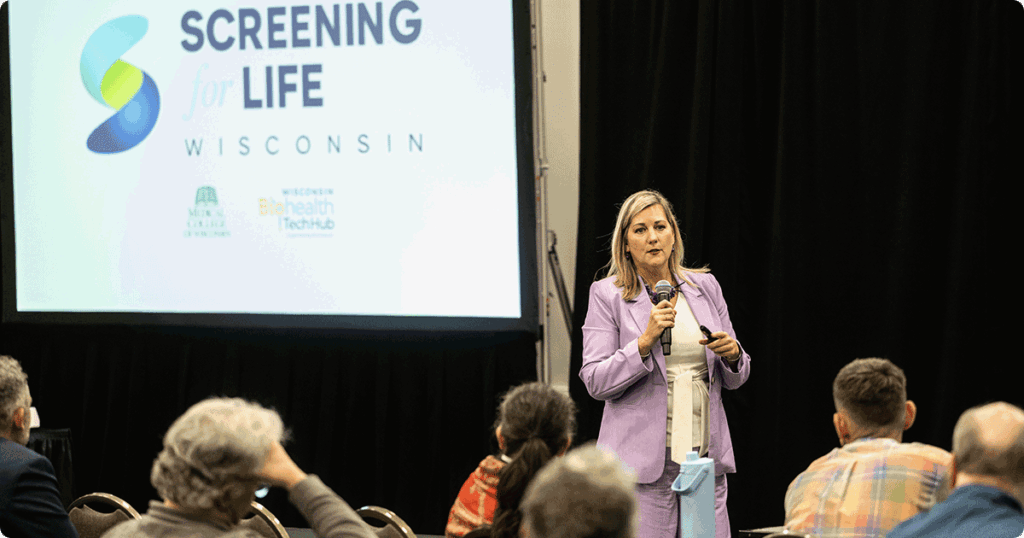
Mara Lord
In 2023, the U.S. Economic Development Administration designated Wisconsin as one of 31 Regional Technology and Innovation Hubs nationwide, thanks to the state’s thriving biohealth industry and the potential for Wisconsin to further develop as a global leader in personalized medicine.
The following year, Wisconsin was designated as a Phase 2 recipient in the program, which more than $80 million in federal funding committed to date. Led by BioForward Wisconsin, the Wisconsin Biohealth Tech Hub brings together world-class healthcare systems, research institutions, manufacturers, and technology companies to enhance the future of medicine.
But what does that look like in practice?
At the 2026 Wisconsin Biohealth Summit on Oct. 21 in Milwaukee—themed “From Molecule to Medicine: Delivering Successful Patient Outcomes”—leaders behind three of the tech hub’s flagship projects discussed the science, technology, and collaboration driving their work.
Moderator Wendy Harris, regional innovation officer for the Wisconsin Biohealth Tech Hub, emphasized that collaboration across multiple disciplines was one of the tech hub’s key strengths. “No one company can really do everything in this space,” she said.
Harris outlined the tech hub initiative and introduced the three projects up for discussion at the biohealth summit in health data infrastructure, mobile cancer screening, and an emerging field called theranostics.
Wisconsin Health Data Hub
Every healthcare organization faces the same challenge, according to Jomol Mathew, chief of biomedical informatics at the University of Wisconsin-Madison School of Medicine and Public Health—and that challenge is fragmented data. With patients receiving care from multiple providers, it is often difficult to get a complete picture of a patient’s medical history, as data doesn’t always follow each medical visit. Researchers face the same problem when trying to conduct large-scale studies.
“The wrong methods or the wrong data can lead to wrong conclusions, which can be life and death for our patients,” said Mathew, project leader at the Wisconsin Health Data Hub.
Mathew and her team are working on a solution that will allow health systems across Wisconsin to connect and share data while still maintaining patient privacy protections. Other groups will benefit, too: Researchers will be able to access geographic information and census data for research subjects. Pharmaceutical companies could identify clinical trial sites. Startups could use datasets to build new artificial intelligence models, and this data will help policymakers better understand public health challenges in Wisconsin.
Mathew said the hub’s mission is about more than just convenience; better data can lead to better decisions, better treatments, and ultimately better patient outcomes.
Screening for Life Wisconsin
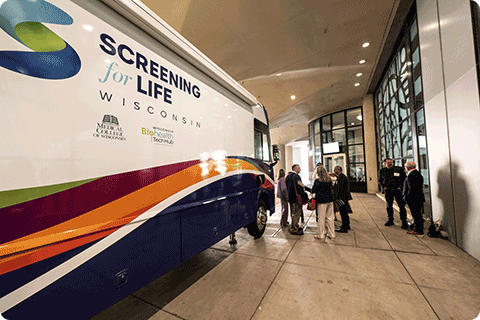 Not everyone can easily access medical care, and this can especially be a challenge for people living in underserved, rural, and Tribal communities. Enter Screening for Life Wisconsin, a mobile health initiative led by Mara Lord, chief strategy and growth officer at the Medical College of Wisconsin.
This project is built around a fleet of ADA-accessible mobile cancer screening clinics that go directly into those Wisconsin communities that struggle to access healthcare. Lord shared examples of Tribal nation members who had to travel 90 minutes or more for diagnostic imaging after receiving a positive screening result.
“We want to be sure that individuals are connected to the care that’s right for them,” said Lord, who emphasized that the most important component of the project isn’t technology, but rather, trust. Many of these communities have seen similar mobile health programs come and go. “Building trust with elders, building trust with community members takes time. But it’s worth it.”
The first mobile health clinic has already hit the road, with plans to add mobile mammography and PET/CT units in 2027. In fact, this particular mobile clinic was parked outside the Baird Center for summit attendees to tour.
“The Baird Center said that if we could get it through the door, we could park it inside. But it is so enormous, we missed it by two inches. So, I suggested we just let the air out of the tires,” said Lord jokingly.
Image-Guided Personalized Therapy

Mara Lord, Wendy Harris, Jomol Mathew, Corinne Brzeski
Theranostics—a blend of “therapeutics” and “diagnostics”—is an emerging field that combines diagnostic imaging with targeted therapies.
Corinne Brzeski, senior project manager at GE HealthCare, discussed the Image-Guided Personalized Therapy project through the Wisconsin Biohealth Tech Hub. While there is a lot of excitement about the science of theranostics, Brzeski said implementing treatments is often challenging.
“Although it’s scientifically amazing, it’s one of those things that feels like a miracle. Operationally, it’s very complex to put together,” she said.
Patients undergoing these therapies often experience long and complicated treatment journeys involving a multitude of medical professionals, as well as insurance companies. With partners at UW Health and Froedtert/Medical College of Wisconsin, GE HealthCare is implementing its Intelligent Radiation Therapy software to streamline workflows, reduce delays, improve patient outcomes, and make treatments more scalable.
“Some of these people are very sick,” said Brzeski. “Taking a couple days off that life cycle could really make a difference.”
She added that hundreds of theranostics therapies are currently undergoing clinical trials, so a solution to operational challenges, such as reducing referral-to-treatment time and improving staff efficiency, is much needed. “Our opportunity,” she said, “is to take this amazing science and make it work in the real world.”
Related Posts