
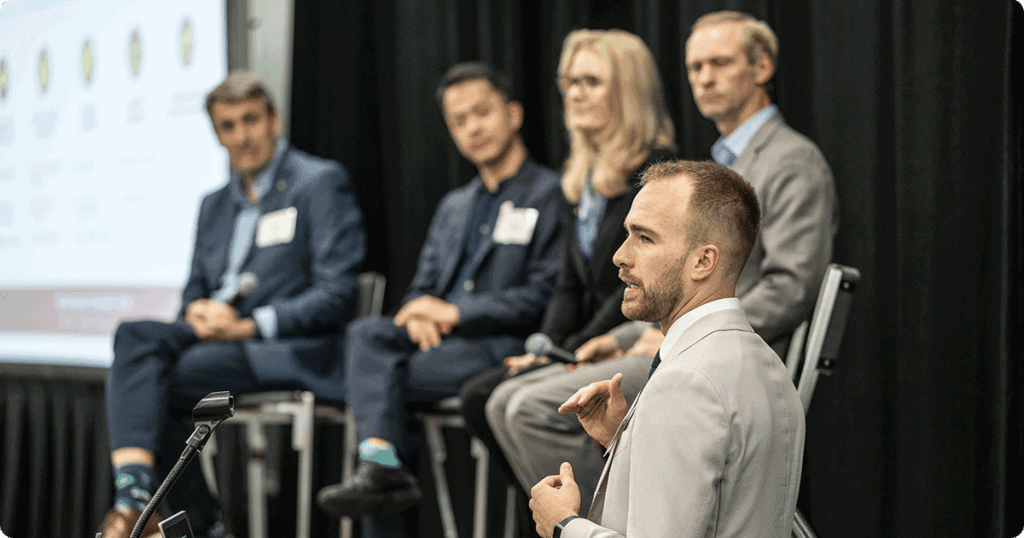
Rome Rauter
For startup founders developing new medical devices, therapeutics, or digital health platforms, international expansion may be a priority that never reaches the top of the list. Between fundraising, hiring staff, finding customers, and navigating complex regulations, it can be challenging to find time to think about global markets—but that topic needs to be a priority for companies that want to grow, panelists said at the 2026 Wisconsin Biohealth Summit.
In the panel discussion, business leaders from Canada, Ireland, Singapore, and the U.S. shared reasons for focusing on international growth and strategies for prioritizing it.
Moderator Rome Rauter, international market development director for WEDC, assured companies that they don’t have to figure it out alone, since WEDC and its partners have initiatives focused export growth and investment attraction.
In practical terms, WEDC connects Wisconsin companies with customers, partners, and investors around the world through export assistance, trade missions, and market and technical expertise.
The international panel included David Brody, vice president of life sciences at IDA Ireland; Wei Theng Sng, regional director at the Singapore Economic Development Board; Robert Oberlies, partner at Fredrikson & Byron in Minneapolis; and Claire Kennedy, consul general of Canada in Chicago.
Going global earlier

Claire Kennedy
“Going global” used to be something U.S. companies considered seriously after years of proven success within our own borders.
Today, that’s changing.
According to Robert Oberlies, a lawyer who advises companies on international mergers, acquisitions, and business development, many biohealth companies are entering international markets much sooner than they had previously. Startups are pursuing global customers, licensing agreements, distribution partnerships, and manufacturing opportunities earlier in their life cycles.
“The timeframe for expansion abroad has really kind of accelerated,” Oberlies said.
In many cases, health care innovation solves universal problems. A diagnostic technology developed in Wisconsin may have customers lining up for it in Europe. A medical device startup serving U.S. hospitals may find similar demand in Canada or Asia.
As panelist Claire Kennedy, Canada’s consul general in Chicago, noted, companies no longer need to be massive corporations before thinking internationally. “You don’t have to be a multi-billion-dollar-listed company to be thinking about global expansion,” she said.
Rauter said that Wisconsin biohealth exports are already reaching customers around the world, with between $2.5 billion and $3 billion in biologic products going to Canada, Korea, Mexico, China, Germany, and France each year.
Growing international opportunities

David Brody
The panel highlighted several regions where Wisconsin companies may find opportunities.
Canada remains Wisconsin’s largest biohealth export market due to a long, shared border, common business practices, and strong cross-border relationships. Kennedy pointed to growing investments in domestic medical manufacturing, vaccine production, and healthcare innovation.
Ireland continues to attract life sciences companies through its deep expertise in pharmaceuticals, medical devices, and manufacturing. “We export about $120 billion in pharmaceuticals and medical devices to Wisconsin,” said David Brody of IDA Ireland.
Singapore, meanwhile, is positioning itself as a gateway to the broader Asia-Pacific market, providing companies access to rapidly growing healthcare markets throughout the region. “We are a small country. Just 6 million people, but we have access to another 290 million in the region,” said Wei Theng Sng of the Singapore Economic Development Board.
Panelists also noted that Asia’s growing population, rising healthcare spending, and increasing adoption of new technologies are creating opportunities that many U.S. companies cannot afford to ignore.
A changing world, growing resilience
Panelists agreed that the pandemic changed how many healthcare and life sciences companies think about growth. The focus used to be on efficiency and cost reduction. Today, resilience has become equally important, as companies rethink how they build supply chains and who they choose as global partners.
What happens if a supplier shuts down or if a world event, like the COVID-19 pandemic, impacts trade?
Due to Canada’s experience during the pandemic, Kennedy said the country is hoping to attract more life sciences production and strengthen healthcare supply chains. “There is a tremendous opportunity in Canada to serve Canadian needs and also … participate in truly a global supply chain,” he said.
Brody said Irish organizations are increasingly creating networks of suppliers, manufacturers, and partners rather than relying on a single location. “They’re now optimizing the optionality and flexibility into their supply chain.”
Despite ongoing uncertainty in global trade, Oberlies said international business activity remains strong: “Cross-border deals keep getting done.”
Ecosystems matter
One of the most interesting ideas to emerge from the discussion had to do with ecosystems.
When companies evaluate where to invest or expand, they are thinking of a bigger picture: Can we find talent? Can we connect with research institutions? Can we easily access health care systems, investors, and suppliers?
Wisconsin has proudly spent years strengthening its ecosystem—its robust network of universities, health care systems, investors, manufacturers, and support organizations—to help companies grow and thrive in the marketplace. The strength of that ecosystem, panelists said, is one reason why Wisconsin’s biohealth industry is on everyone’s radar all over the world.
Related Posts