
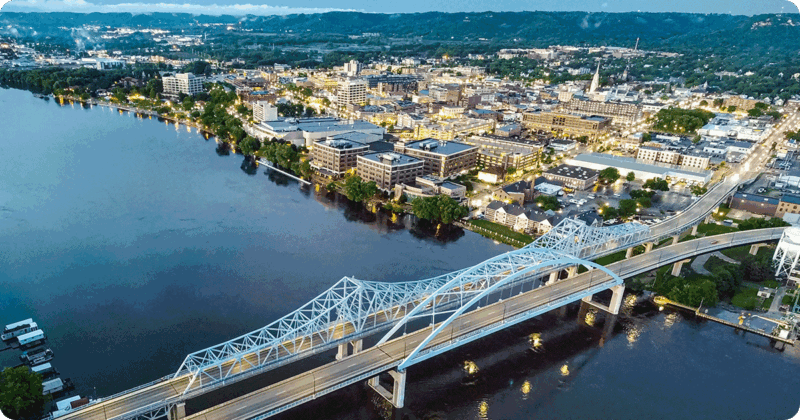
La Crosse is one of Wisconsin’s high-performing downtown districts.
A recent report highlights the state of Wisconsin downtowns, featuring the 37 current and four aspiring Main Street districts. Downtowns are often seen as the heart and soul of cities, serving as the economic, cultural, and social core of their communities. This month’s newsletter highlights the successes of Wisconsin’s downtowns and gives a peak under the hood of the report.
When determining how to best assess the state of Wisconsin downtowns, WEDC drew inspiration from The Value of U.S. Downtowns and Center Cities: Trends Report for 2024, authored by the International Downtown Association (IDA). Based on criteria in this report, WEDC identified three categories of downtowns in Wisconsin: emerging, growing, and established. Downtowns were placed into these categories by determining rate of growth, citywide share of residents and jobs, density of residents, and assessed land values per square mile. Downtowns with the greatest density, land value, and share of citywide resources made up the established tier. Other downtowns fall into the growing or emerging tiers based on how quickly they are growing. The trends report identified five key principles–economy, inclusion, housing, vibrancy, and resilience–and analyzed more than 50 key metrics within these principles to quantify the value of a given Wisconsin downtown.
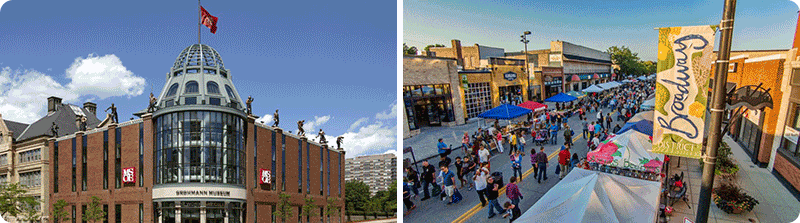
Milwaukee and Green Bay are two of Wisconsin’s largest cities, and their Historic King Drive and Broadway District are two of the most valuable downtowns in their regions.
Downtown economy
Downtowns in Wisconsin have long been vital hubs of regional activity that are central to the financial well-being of municipalities. As focal points for employment, development, and cultural identity, they naturally attract a concentration of valuable real estate. Investigating land value data over a nearly 10-year period (2015-2024), it was found that Wisconsin downtowns grew significantly in value in each of the emerging, growing, and established categories. Downtown community land values grew by 48.7% in the last decade, as the evolution of downtowns into more vibrant, mixed-use neighborhoods that support living, working, and recreation has created an even more robust economic base.
Complementary to raw land value, the total number of businesses and blocks within a given downtown also tracks with a community’s development. From emerging to growing to established, the more developed a downtown is, the more you can expect high numbers of businesses and a greater number of city blocks within the district. Similarly, the number of downtown employees grows with the relative development of a city. Highly developed downtowns like Historic King Drive in Milwaukee can accommodate more than 4,000 employees. And La Crosse boasts nearly 6,000 individual business entities within its downtown district, 85% above the established downtown average. Nationally, in 2000, there were six workers per resident in a typical downtown. As of 2021, that ratio had shrunk to four workers per resident, due in large part to ongoing residential growth downtown. Together, these numbers tell a clear story: Wisconsin’s downtowns are helping communities grow. Whether emerging or long established, each city plays a vital role in strengthening its local economy and sense of place.
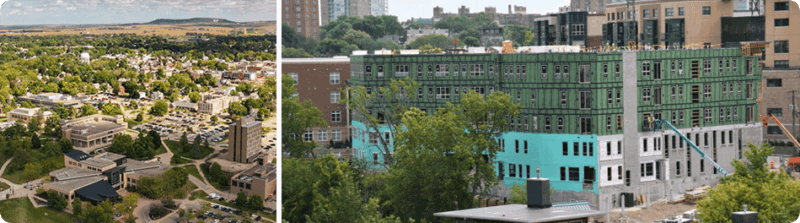
The University of Wisconsin-Platteville and Milwaukee mid-rise apartment development symbolize the changing demographics of Wisconsin downtowns.
Downtown people
Wisconsin downtowns are, in general, highly educated, with roughly a quarter of residents age 25 and older holding college degrees. Downtown residents also tend to be young, racially diverse, and well-educated. This trend is even more apparent in communities that host colleges and universities. In De Pere, home of St. Norbert College, nearly 40% of the downtown population are degree holders. Similarly, in La Crosse, 37% percent of downtown residents have degrees, as the University of Wisconsin-La Crosse campus is located near downtown.
High rates of homeownership is also a unique attribute of Wisconsin downtowns as compared to larger districts throughout the nation. Across Wisconsin’s emerging, growing, and established categories, nearly 60% of residential units are owned rather than rented, creating a stable customer base for downtown businesses.
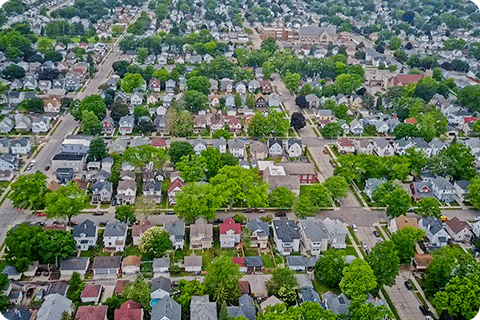
Single-family housing in Racine has high rates of homeownership with increasing demand for rental properties.
Perhaps because of the larger number of owners, incomes remain high in Wisconsin’s downtown areas–nearly $10,000 higher than the national average. Current corresponding rents show emerging communities to have average prices below $1,000 in monthly rent. This suggests great affordability in emerging downtowns, especially when considering that the average income of district residents is above $60,000 a year.
Downtown housing
Though downtown rents remain relatively low, they are increasing at rates that outpace citywide averages. This is especially true in growing downtowns as they near the established categorization. Established downtowns have nearly 600 housing units within their boundaries–that’s almost double the number of residential units in emerging communities. This reflects the integral role housing plays in the development of downtown communities.
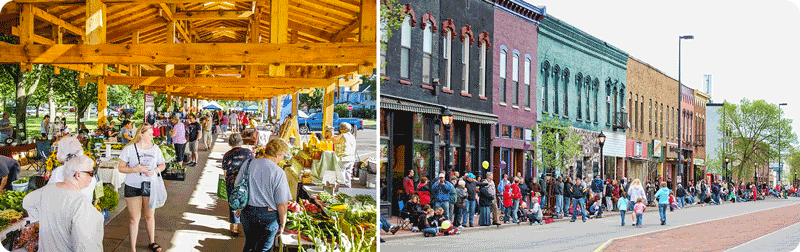
A Menomonie farmers market and Eau Claire street festival depict the foot traffic, volunteerism, and overall vibrancy common in Wisconsin downtowns.
Downtown vibrancy
Geofencing data shows average yearly foot traffic in the millions for downtown communities in Wisconsin. In contrast with other data, emerging downtowns have outpaced both growing and established downtowns in the share of visitors they attract. About a quarter of all foot traffic in emerging communities was to the downtown area, with more than 2 million unique visits. Foot traffic generally increases with the number of downtown events that take place, ranging from weekly farmers markets to large community events.
Volunteerism symbolizes the strength of a community by showing the willingness of ordinary citizens to provide for one another. Wisconsin downtowns display an impressive amount of volunteer hours across emerging, growing, and established categories. Nearly every reporting downtown boasts 1,000 volunteer hours over the previous year. Standout communities include Ashland, Lake Mills, Stevens Point, Green Bay, and Port Washington–all of which have more than 2,000 volunteer hours recorded. Volunteer opportunities allow citizens to become engaged with their neighbors downtown. Beyond offering free labor for civic causes, volunteering gives people a hands-on experience that strengthens their relationship to their home.
Downtown resilience
Downtowns facilitate a highly environmentally friendly lifestyle by bringing workplaces, residences, services, and recreation together in close proximity in dense and walkable neighborhoods, which also typically feature a tightly knit network of biking and transit infrastructure. In their commute to work, downtown residents are far more likely to walk, bike, or take transit to work, a testament to the mixed-use nature of downtowns.
Across Wisconsin’s downtown communities, walk score and bike score are directly proportional to whether a community is emerging, growing, or established. The majority of Wisconsin downtowns can be slotted into the “very walkable” category, meaning most errands can be accomplished on foot. Established downtowns have built up an infrastructure more conducive to a pedestrian or a cyclist. This usually includes pedestrian malls, separated bicycle lanes, and automobile traffic calming measures such as speed bumps and signage. Growing and emerging communities are often still developing these measures in their downtown districts. Making downtowns a safe, open space where people can freely transit between businesses and blocks develops inviting districts distinct from other parts of the city. Wisconsin downtowns that can brag about being a “walker’s paradise” include Fond du Lac and Racine. And La Crosse and Green Bay are solidly within the “biker’s paradise” category.
The state of Wisconsin downtowns
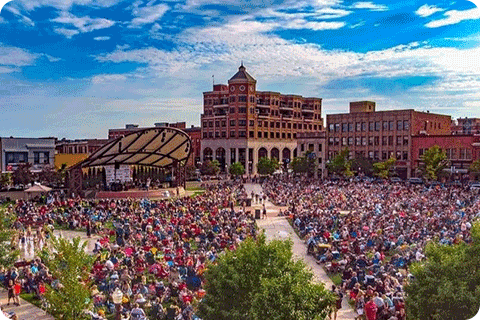
A concert in downtown Wausau brings community together in a uniquely walkable built environment.
City centers have always also been nodes of economic prosperity, cultural richness, vibrant street life, communal identity, and societal resilience. The future of our cities depends a great deal on the success of our downtowns–the median Wisconsin downtown has assessed land values of $393.3 million per square mile. This growing economic value and potential can establish Wisconsin downtowns as keystones of their cities, counties, regions, and state far into the future. Greater emphasis on mixed-use real estate, continued residential growth, and further emphasizing arts, culture, entertainment, and accommodation assets will ensure prosperity and vibrancy in Wisconsin downtowns in the years to come.
